
Today, Fresenius has launched the AI-powered assistant – “AskFRE” – on its Investor Relations (IR) website, marking an important step in advancing its digital capital markets communications. The solution is a joint initiative of the Fresenius AI Center of Excellence and the Investor Relations team.
With AskFRE, visitors can now interact with an integrated AI chatbot that provides direct answers to capital market-relevant information. This includes financial results, company updates and other IR content – based exclusively on publicly available Fresenius disclosures.
In an increasingly fast-paced and data-driven environment, digital investor relations play a key role in delivering timely, transparent and stakeholder-focused communication. AskFRE supports this ambition by enabling more intuitive access to financial information and tailored user interactions, while reinforcing the consistency and accessibility of Fresenius’ disclosures.
With AskFRE, Fresenius underscores its commitment to advancing a best in class digital investor relations experience.
AskFRE is now available: https://www.fresenius.com/AskFRE-Your-IR-Assistant
Today, Fresenius has launched the AI-powered assistant – “AskFRE” – on its Investor Relations (IR) website, marking an important step in advancing its digital capital markets communications. The solution is a joint initiative of the Fresenius AI Center of Excellence and the Investor Relations team.
With AskFRE, visitors can now interact with an integrated AI chatbot that provides direct answers to capital market-relevant information. This includes financial results, company updates and other IR content – based exclusively on publicly available Fresenius disclosures.
In an increasingly fast-paced and data-driven environment, digital investor relations play a key role in delivering timely, transparent and stakeholder-focused communication. AskFRE supports this ambition by enabling more intuitive access to financial information and tailored user interactions, while reinforcing the consistency and accessibility of Fresenius’ disclosures.
With AskFRE, Fresenius underscores its commitment to advancing a best in class digital investor relations experience.
AskFRE is now available: https://www.fresenius.com/AskFRE-Your-IR-Assistant
- Large majority approves actions of General Partner and the members of the Supervisory Board
- Dividend of €1.05 per share agreed
At today’s Annual General Meeting, the shareholders of Fresenius SE & Co. KGaA approved the proposals of the General Partner and the Supervisory Board with a large majority.
The actions of the General Partner and the members of the Supervisory Board in 2025 were also approved, by 99.41 percent and more than 96 percent respectively. 99.77 percent of shareholders voted in favor of approving the annual financial statements. 92.61 percent approved the compensation report for the 2025 financial year and 99.99 percent approved the dividend proposal of €1.05 per share. A large majority also approved the creation of new conditional capital and authorized capital, and authorized the buyback of its own shares as well as the conversion of bearer shares to registered shares. This will enable transparent, direct communication between Fresenius and its shareholders.
76.62 percent of the share capital was represented at the AGM.
This release contains forward-looking statements that are subject to various risks and uncertainties. Future results could differ materially from those described in these forward-looking statements due to certain factors, e.g. changes in business, economic and competitive conditions, regulatory reforms, results of clinical trials, foreign exchange rate fluctuations, uncertainties in litigation or investigative proceedings, the availability of financing and unforeseen impacts of international conflicts. Fresenius does not undertake any responsibility to update the forward-looking statements in this release.
Fresenius SE & Co. KGaA
Registered Office: Bad Homburg, Germany / Commercial Register: Amtsgericht Bad Homburg, HRB 11852
Chairman of the Supervisory Board: Wolfgang Kirsch
General Partner: Fresenius Management SE
Registered Office: Bad Homburg, Germany / Commercial Register: Amtsgericht Bad Homburg, HRB 11673
Management Board: Michael Sen (Chairman), Pierluigi Antonelli, Sara Hennicken, Robert Möller, Dr. Michael Moser
Chairman of the Supervisory Board: Wolfgang Kirsch
- Thanks to its disciplined execution of #FutureFresenius, Fresenius is today stronger than ever before. Rejuvenate is paying off and delivering accelerated performance for long-term value creation. With its combination of operating strength and resilience, Fresenius is today able to actively help shape the healthcare of the future.
- Shareholders’ trust is to be rewarded: proposed dividend of €1.05 per share – an increase of 5% compared to last year
Despite the mounting geopolitical uncertainty, Fresenius healthcare group had a very good 2025 and entered 2026 with strong momentum. “Fresenius is financially flexible, operationally strong, and strategically focused – and therefore ideally positioned to actively help shape the future of healthcare. This is the result of a future-focused strategy that a strong and highly competent team developed and implemented with discipline in recent years,” said Wolfgang Kirsch, Chairman of the Supervisory Board of Fresenius, at today’s Annual General Meeting in Frankfurt am Main.
2025 marked the start of the third phase in the #FutureFresenius strategy: Rejuvenate. The aim is to make the company more innovative and resilient while continuing to create long-term value for customers and patients. The financial results for 2025 and the first quarter of 2026 make clear: Rejuvenate is paying off and delivering accelerated performance for long-term value creation. The shareholders’ trust should also be rewarded: The proposed dividend of €1.05 per share corresponds to a 5% increase compared to last year.
Michael Sen, CEO of Fresenius, emphasized: “In the past financial year, we showed that Fresenius can deliver a strong performance even in an environment where volatility has become the norm. We further strengthened our balance sheet, raised our full-year guidance twice during the year, and delivered on our commitments. At the same time, we continued to make targeted investments in innovation and digitalization – from new product launches to AI-supported hospital platforms. In doing so, we are strengthening Fresenius and laying the foundations for our long- term success.”
Every year, Fresenius invests more than €600 million in R&D within its core businesses – for example, in intravenous generics, biosimilars, infusion and nutritional therapies, and medical technology. The hospitals of Quirónsalud and Helios are actively involved in medical research, with more than 1,700 clinical studies and over 3,100 scientific publications in 2025. Patients benefit directly from this research through access to cutting-edge therapies and care.
The company moreover continues to strategically advance digitalization and the use of AI in healthcare. One building block is the strategic partnership between Fresenius and SAP. The objective of this collaboration is to build an open, interoperable, AI- enabled digital healthcare ecosystem for Germany and Europe. As announced in early May, Fresenius and SAP have invested jointly in Avelios Medical, a start-up developing a next-generation, cloud-native hospital information system.
This release contains forward-looking statements that are subject to various risks and uncertainties. Future results could differ materially from those described in these forward-looking statements due to certain factors, e.g. changes in business, economic and competitive conditions, regulatory reforms, results of clinical trials, foreign exchange rate fluctuations, uncertainties in litigation or investigative proceedings, the availability of financing and unforeseen impacts of international conflicts. Fresenius does not undertake any responsibility to update the forward-looking statements in this release.
Fresenius SE & Co. KGaA
Registered Office: Bad Homburg, Germany / Commercial Register: Amtsgericht Bad Homburg, HRB 11852
Chairman of the Supervisory Board: Wolfgang Kirsch
General Partner: Fresenius Management SE
Registered Office: Bad Homburg, Germany / Commercial Register: Amtsgericht Bad Homburg, HRB 11673
Management Board: Michael Sen (Chairman), Pierluigi Antonelli, Sara Hennicken, Robert Möller, Dr. Michael Moser
Chairman of the Supervisory Board: Wolfgang Kirsch
When the spine is operated on, mere millimeters can be critical. For such highly complex procedures, surgeons need sound judgment, precise spatial awareness, the capacity for abstraction – and a skilled pair of hands. Yet by their very nature, humans frequently reach the limits of their abilities. That is why many hospitals have for a long time been using high-resolution three-dimensional images and surgical navigation systems, such as spinal navigation, to perform their work. But all of this is only the start.
(Published: August 2025)
The Department of Neurosurgery and the Center for Spine Therapy at Helios Hospital Berlin-Buch have continued to build on their expertise in spinal surgical procedures: Under the direction of chief physician Professor Yu-Mi Ryang, the department has been using augmented reality (AR) in spinal stabilization surgery for the past two years. Berlin-Buch is thus one of the first hospitals in Germany to use AI in neurosurgery for the benefit of patients. The AR technology makes the procedures more precise, less invasive, and also shorter. A look over the shoulder of Prof. Ryang reveals exactly how AR is used here and why this represents an important step into the future.
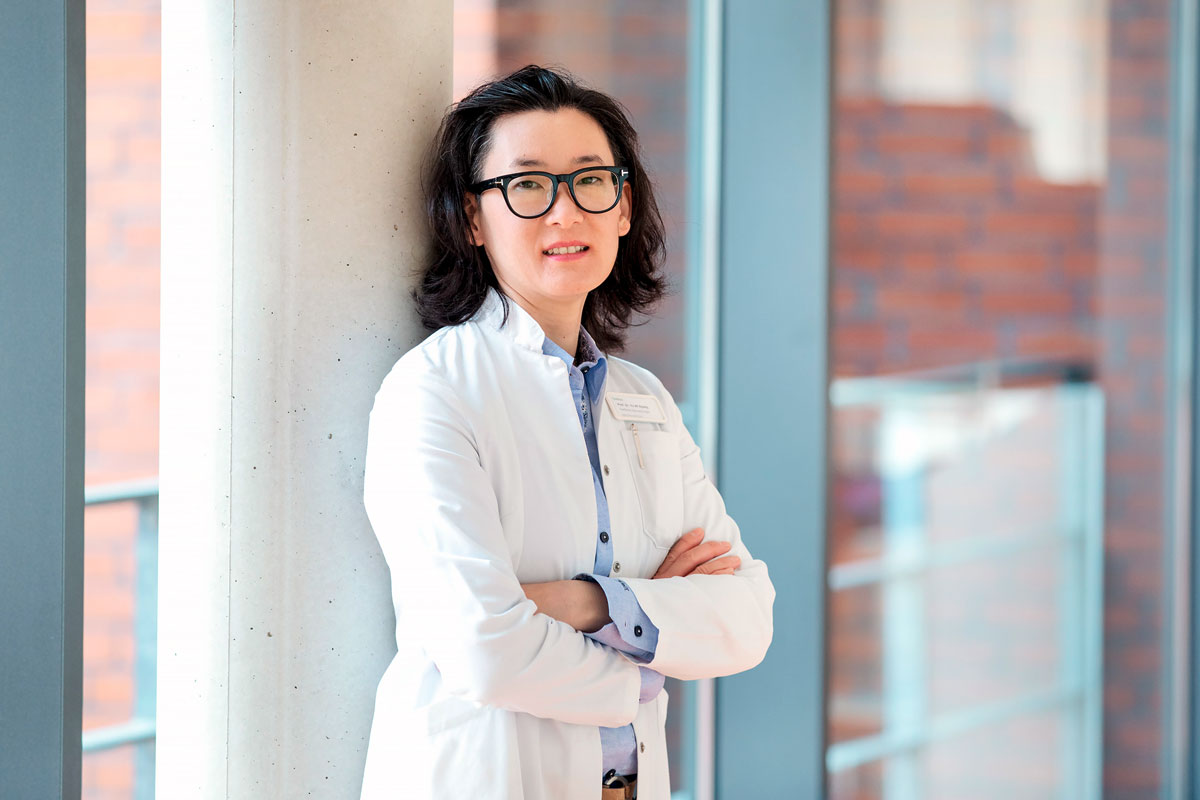
There is total concentration in the operation room. Prof. Ryang is leaning over her patient. He is suffering from a spinal tumor that has already partially destroyed the bones and is also pressing on the highly sensitive spinal cord. Over the course of the next two to three hours, the surgeon will remove the tumor from the spinal cord and strengthen the area of the spine destabilized by the tumor using a so-called screw and rod system. It should restabilize the spine and, above all else, free the patient from pain. The neurosurgery teams also use such minimally invasive techniques for other indications, combining them with AR technology – in frequently occurring cases of wear and tear of the spine, for example, as well as when repairing fractured vertebrae after an accident or treating osteoporosis.
In purely visual terms, this screw and rod system resembles a railroad track. Firstly, between four and eight, sometimes significantly more, screws are firmly anchored in the “track bed” – i.e. the vertebral bodies. To this end, the screws are attached to so-called towers, which function as a kind of screw extension. Without these towers, the screws would disappear into the depth of the surgical area when inserted. They would no longer be visible to the surgeon and would hardly be accessible through the back muscles.
All of this is preferably performed in a minimally invasive procedure by making small incisions in the skin in order to preserve the tissue and reduce blood loss. Other advantages of this tissue-preserving procedure include a shorter operating time. This is because there is no longer any need for the complex process of detaching the back muscles from the spine, as is the case with open procedures. The patient also suffers less postoperative pain.
Due to the minimally invasive technique, Prof. Ryang may only be able to see a small section of the surgical area with her own eyes, but this is no obstacle thanks to AI. The precise location where the rods have to be inserted and, above all, the required length and curvature, along with the location of other important structures of the spine – such as the spinal cord or the tumor itself – can all be shown to her with the help of augmented reality. The latter also increases the safety of the procedure.
As the operation progresses, things get tricky again: Depending on the curvature of the spine, Prof. Ryang has to shape the titanium rods in advance so that they fit perfectly into the screw heads. Being even a few millimeters out can make a big difference here. In the past, the team relied purely on operative experience and their own judgment when shaping and fitting the rods. “This can be extremely difficult, however, particularly with severe curvatures of the spine,” explains the surgeon. Furthermore, it is relatively time-consuming. This is precisely where AR can now help: “With the aid of augmented reality, we can determine the ideal position, length, and curvature of the rods during the ongoing operation in a matter of minutes and prepare them accordingly.”
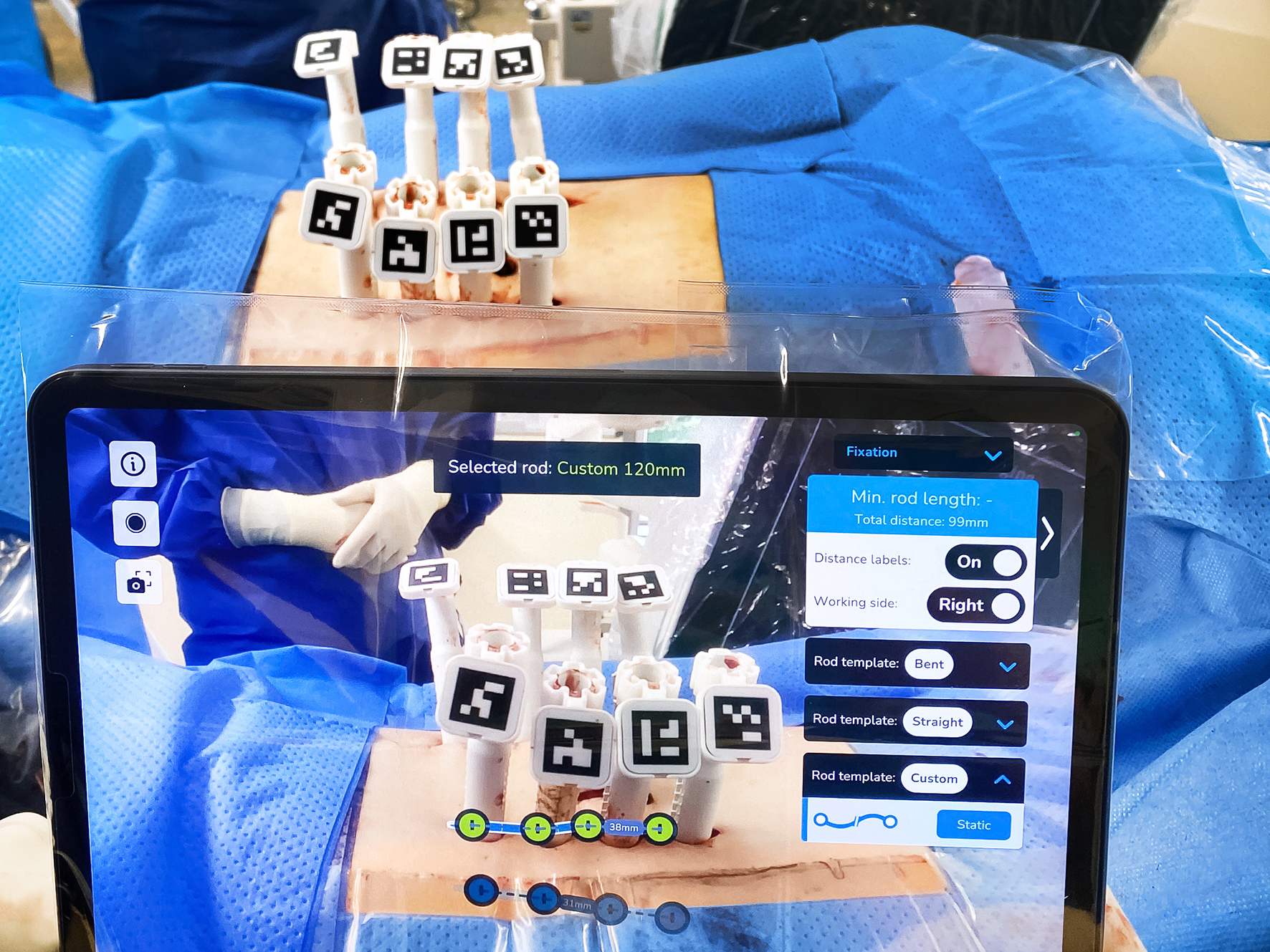
When the term augmented reality (AR) is mentioned, many people tend to think of virtual reality (VR) headsets. In Berlin-Buch, however, the neurosurgery team works with standard tablets equipped with a built-in camera and special software. Dr. Ryang points the tablet camera at the patient’s back. By swiveling the tablet, the surgical area is scanned – and with it the QR codes affixed to the screw tower in advance. The virtual 3D towers and virtual rods then gradually appear on the tablet, which are assigned to the real-time image of the patient. “Changes in position during the procedure are also no problem for me – orientation is guaranteed at all times,” says Prof. Ryang. With the aid of the QR codes, the tablet’s integrated camera can determine the exact position of the inserted screws and the exact length and curvature of the rods. And it can “merge” with the patient’s real-time image as a virtual 3D image. Based on this augmented reality, the surgeon can then use the tablet to create custom rods for each individual patient.
The software works out a kind of template for this, enabling the surgeon to bend the titanium rods into the ideal shape by hand. To allow her to compare, she repeatedly places the rods on the template. In the past, if the rod was not perfectly bent, a screw could be ripped out of its position again after being inserted. The doctor says that this risk is now minimal: “We hope that there will be significantly fewer postoperative complications in the long term, such as a broken rod, a loose screw, or some other material failure. Any of these things would necessitate revision surgery. We also hope that this method will improve the clinical outcome of patients in terms of pain and quality of life.”
The neurosurgery team in Berlin-Buch has been using AR technology for about two years now. At the present time, the interim assessment looks promising: Several studies have shown that it improves operative performance. “Even highly experienced surgeons are not always able to set the ideal curvature radii of the screw and rod systems without augmented reality support,” says Dr. Ryang. “But with the help of AR, practically all surgeons are able to achieve perfect results.”
Yet it gets even better with augmented reality: AR-supported procedures lead to shorter operating times, thereby also reducing the length of time the patient spends under anesthetic. This represents a continuation of the positive trend seen in spinal treatments, with minimally invasive neurosurgical procedures on the back becoming more and more comfortable for the patient.
“Our example from Berlin-Buch shows what it means to bring a medical innovation to patients in a very practical way,” says a delighted Prof. Ryang. “It is not the one major revolution that changes everything overnight. Rather, we combine various innovative solutions to achieve better outcomes for our patients step by step,” says the expert in summary.
Top specialist in neurosurgery
Prof. Yu-Mi Ryang studied at Ruhr University Bochum, where she also gained her doctorate. The Düsseldorf-born physician then worked in the field of neurosurgery at University Hospital RWTH Aachen, where she completed her specialist training. Prof. Ryang attained her professorship at the Klinikum rechts der Isar of the Technical University of Munich and was appointed senior physician and deputy director of the Neurosurgical Department and Polyclinic in 2017. The specialist joined Fresenius Helios in Berlin-Buch in 2019. As chief physician, she heads the Neurosurgical Department as well as the Center for Spine Therapy.
She also holds a number of positions in various national and international professional societies, including the German Society of Neurosurgery, or DGNC, where Prof. Ryang is currently head of the spine section. In addition, she is on the board of the German Spine Society (DWG), where she serves on various commissions and is chairwoman of Module 5 of the DWG’s basic courses. In EUROSPINE, Prof. Ryang is also chairwoman of Module 4, and in AO Spine she is a member of the Technical Commission and the “Fracture, Tumor, Deformity Expert Group.”
(Published: March 2025)
The expert committee is made up of four international specialists from the fields of science, business, and consulting. It was established by Michael Moser, member of the Management Board, and helps Fresenius to further develop its sustainability strategy. Yesterday’s meeting focused on key issues such as water management and the ongoing development of the Group-wide human rights program.
Sarah Tix, Head of Group Sustainability, and Anahita Thoms, co-chairs of the Advisory Board, took time out from a tour of the plant to explain the importance of sustainability issues - start the video on the right.
Fresenius Kabi’s Friedberg site supplies essential medical devices used in the care of critically and chronically ill patients in more than 100 countries. Around 650 employees work at the plant. Every year, more than 125 million infusion solutions and around 70 million liquid medicines such as analgesics and narcotic agents are manufactured here. The adjacent logistics center puts together around 40,000 consignments every month and is responsible for packing and shipping them.