

Human Rights
As a global healthcare company, we have a responsibility towards people – in our daily operations, our business relationships, and throughout our value chains. Our business activities may be connected to impacts on different stakeholder groups. Respect for human rights is therefore a fundamental part of how we conduct business.
The graphic below illustrates how our business activities may be connected to potential human rights impacts and which stakeholder groups may be affected.
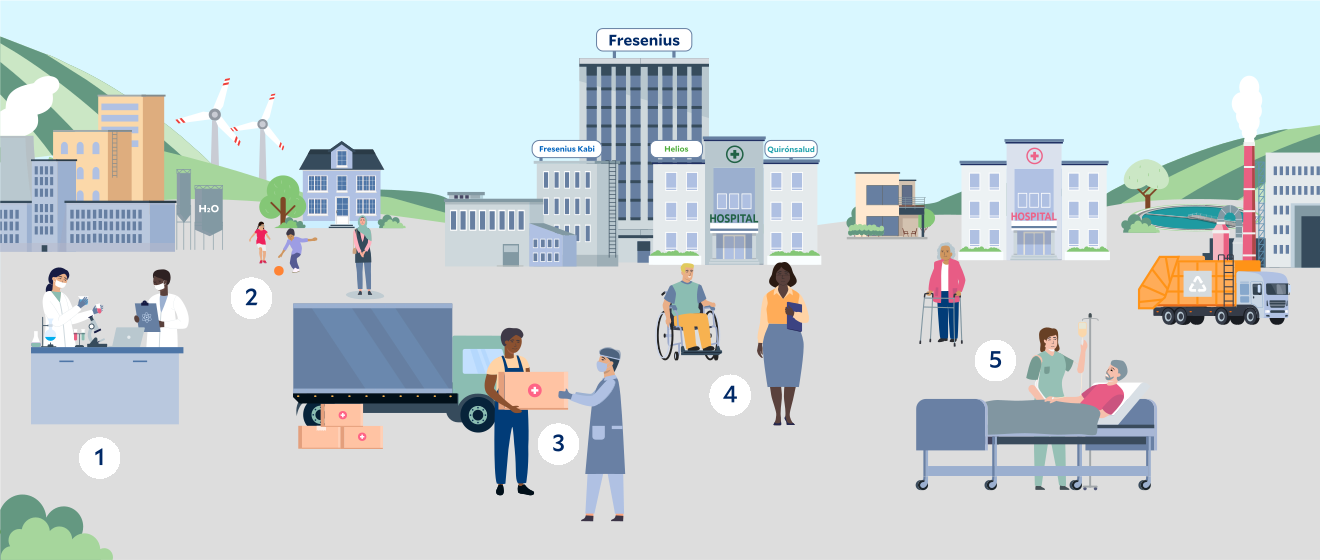
The persons and stories depicted in this image are purely fictional. Any resemblance to actual persons is purely coincidental and unintentional.

Anjing and Lisa work on preliminary products which we obtain from our suppliers. We then process these products in our own production facilities – to manufacture medical technology, for example, that helps treat people in hospitals. We expect our suppliers to respect the human rights principles laid out in our Human Rights Statement and our Codes of Conduct for Business Partners – in both their own activities and in their value chains. This is because the work carried out by people such as Anjing and Lisa, who are part of our value chain, may involve human rights risks or even violations of human rights. We are committed to doing everything within our power to take appropriate preventive or remedial activities.

Dunya lives with her children next to one of our production sites. Even though she is neither working on preliminary products nor employed by Fresenius, her human rights must be respected. For instance, Fresenius is responsible for preventing water and air pollution and excessive noise pollution to support the well-being of people like Dunya and her children.

Alejandro works for a logistics company that helps Fresenius in transporting medical products and medical technology. As a direct contractual partner, his company is an important part of our value chain. We take a risk-based approach and analyze the potential impacts on people like Alejandro. Where necessary, we take additional preventive activities.

Chi, Benjamín, Shiva, and Carmen work for Fresenius. Despite their different professions and areas of responsibility, they have one thing in common: Their employer Fresenius is responsible for respecting their human rights in the workplace by providing appropriate protective equipment when dealing with patients. It also includes making sure that people like Chi, Benjamín, Shiva, and Carmen are trained to handle equipment and adhere to at least the statutory break and rest periods.

We do our best every day to keep millions of patients like Najuk and Valentina healthy. Whether in hospital, at home, or as outpatients, they are part of our value chain. While Najuk is treated in hospital, Valentina receives our medication at home. The well-being of Najuk, Valentina, and all our patients is at the heart of our human rights due diligence obligations.
The core elements of our human rights program
The examples above illustrate how our business activities may be connected to people and potential human rights impacts. To identify, assess, and responsibly address such risks, we have established a Group-wide Human Rights Program rooted in our commitment to respect human rights in our own operations and throughout our value chain.
The Program consists of five core elements. Together, they translate the principles of our Human Rights Statement into concrete processes, responsibilities, and activities across all Operating Companies.
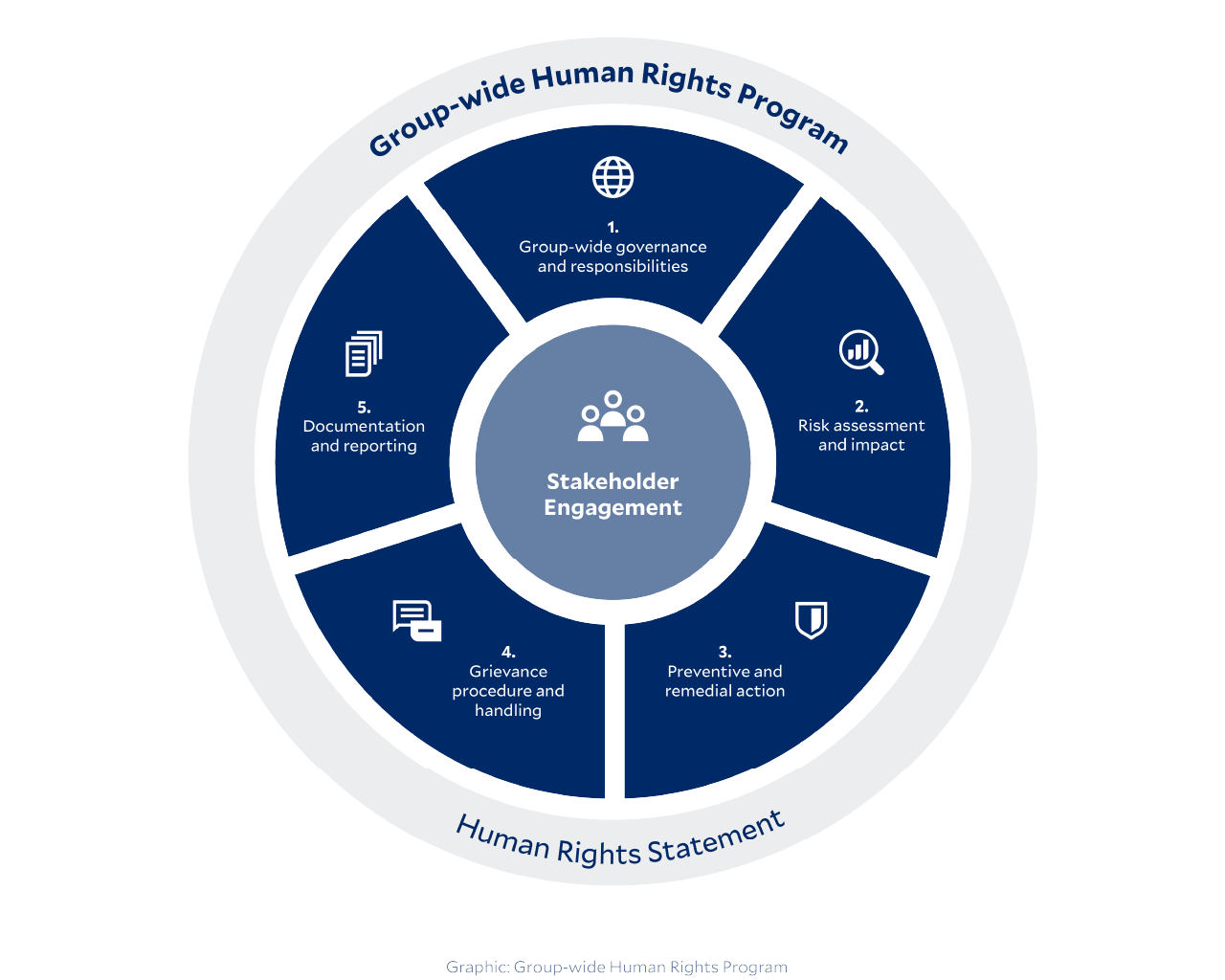
A key objective of our Human Rights Program is to understand the perspectives of potentially affected people and their representatives and to incorporate them into our human rights due diligence processes.
We therefore seek ongoing dialogue with relevant stakeholders and their representatives and continue to expand these efforts. Their experiences and perspectives help us better understand risks, set priorities, and continuously enhance our Human Rights Program.
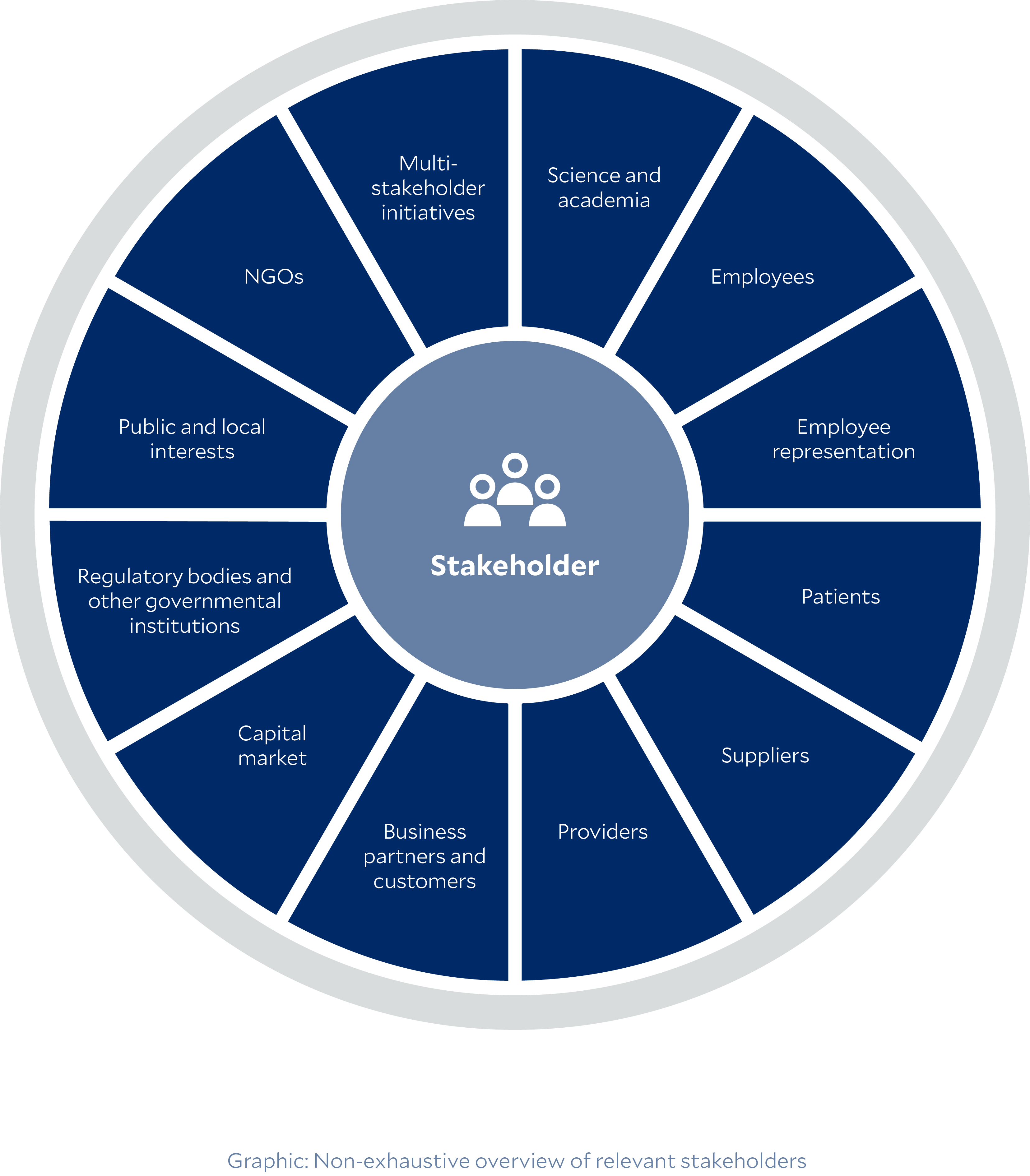
The graphic below provides illustrative examples of stakeholder groups that may be particularly exposed to such risks. The overview is not exhaustive.
Human rights priority areas
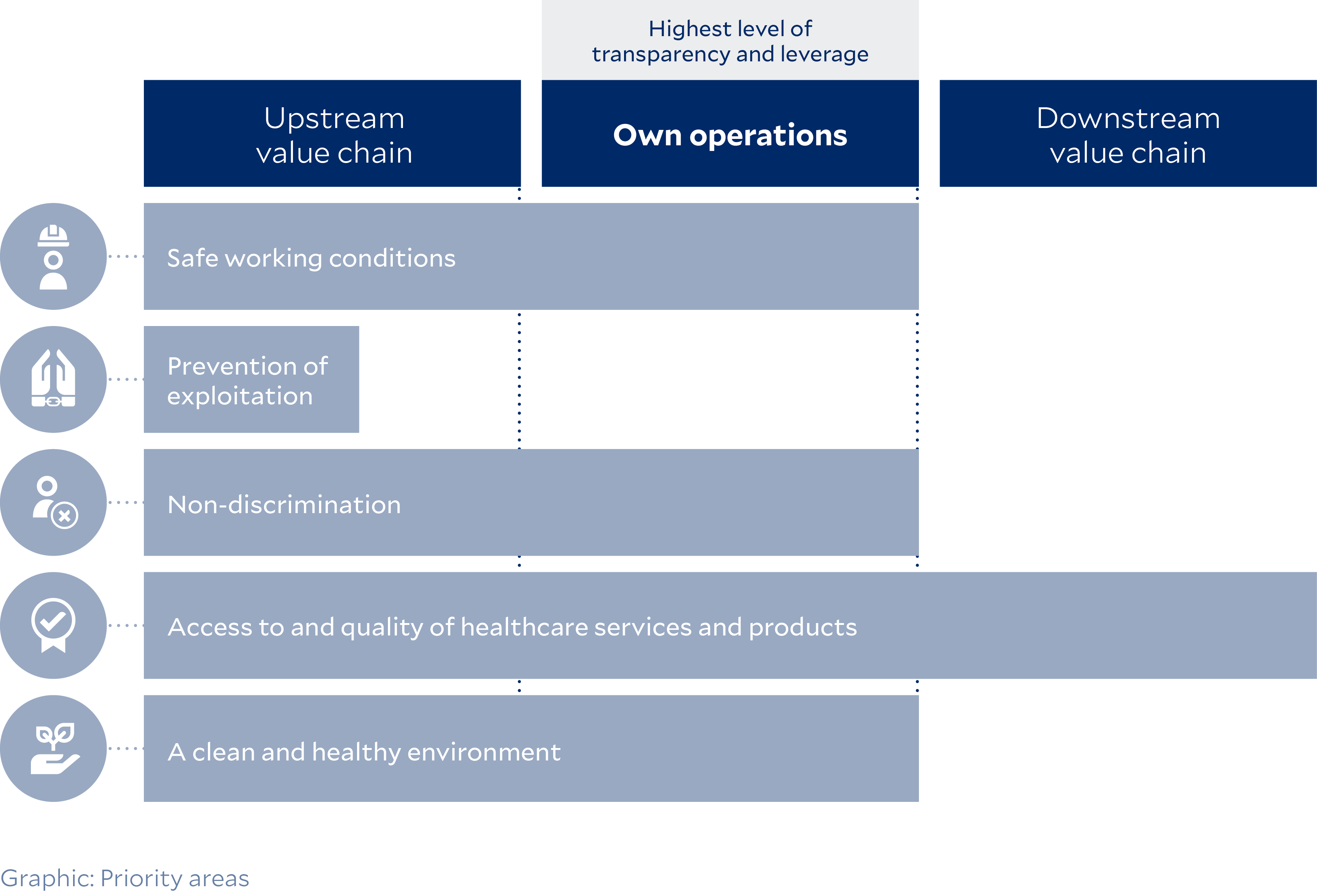
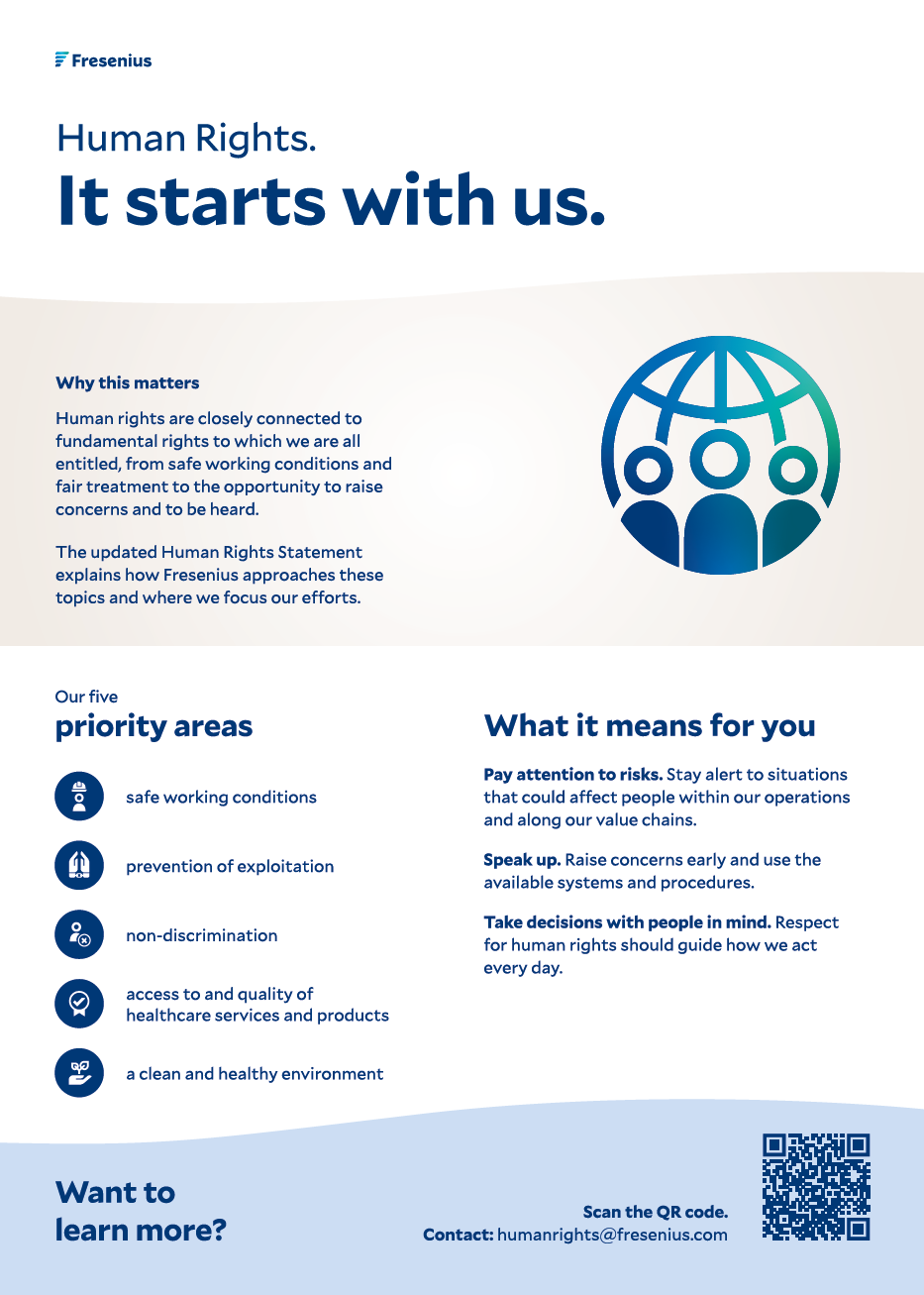
Based on our business activities, procurement structures, and global footprint, we have identified five strategic human rights priority areas. These highlight where human rights risks are more likely to arise and where our business activities may potentially impact people.
The priority areas were defined through a structured assessment of potential human rights impacts across our own operations and throughout our value chains. As our business activities and operating environment continue to evolve, these priority areas are subject to regular review.
Understanding the priority area
We operate across complex global value chains involving a wide range of workers and activities. In some countries and sectors, workers may face heightened human rights risks, including unsafe working conditions, restrictions on freedom of association, excessive working hours, wages below the legal minimum, or harmful recruitment practices. These risks may affect both Fresenius employees and workers throughout our value chains, particularly in areas where transparency is more limited.
How we address the priority area
We are committed to fostering a respectful workplace with safe and healthy working conditions and wages that meet or exceed local requirements. We respect and uphold workers' freedom of association, in line with applicable laws. These commitments are embedded in our internal standards, including the Group Social Labor Standards Guideline and the Group Code of Conduct, and are supported through training and awareness-raising activities. We expect our business partners to uphold similar principles, as outlined in our Third-Party and Supplier Codes of Conduct. In addition, our sites may apply externally certified standards and management systems, where appropriate.
Understanding the priority area
Forced labor and child labor remain significant human rights risks in global value chains, particularly in upstream supply chains where transparency may be limited. Depending on the country, sector, and workforce composition, workers may face coercion, deception, debt bondage, or other forms of exploitation. Children may be exposed to work that interferes with their education, development, or wellbeing. Such risks can arise in activities such as raw material extraction, manufacturing, or certain service sectors, and may be more prevalent where labor protections are weak or where low-skilled or migrant labor is common.
How we address the priority area
We strictly reject all forms of forced labor, child labor, coercion, and violence, and support adherence to applicable minimum age requirements. Employment must always be voluntary, and employees may leave their employment with reasonable notice in accordance with local laws. These expectations are reflected in our internal standards, including the Group Code of Conduct and the Group Social Labor Standards Guideline. We continuously strengthen our controls and other preventive activities to support their implementation. We also expect our business partners to uphold comparable standards, as set out in our Business Partner or Third-Party Codes of Conduct.
Understanding the priority area
Discrimination can occur in the workplace and in the provision of healthcare across Fresenius’ operations and value chains. In certain regulatory, social, or sectoral contexts, workers, job seekers, and patients may face unequal treatment based on personal characteristics. Such risks may arise in processes such as recruitment, remuneration, working conditions, career advancement, and access to healthcare. Individuals from marginalized groups may be particularly affected.
How we address the priority area
We are committed to ensuring equal opportunities for all and oppose discrimination of any kind. Our approach is guided by applicable laws and anti‑discrimination regulations, and we expect all workplace interactions to be guided by respect, fairness, and appreciation. Insults, harassment, and any other form of discriminatory behavior are not tolerated. These principles are reflected in our internal standards, including the Group Social Labor Standards Guideline and the Group Code of Conduct, and are supported through training and awareness-raising activities. We also expect our business partners to uphold comparable standards, as set out in the Third-Party and Supplier Codes of Conduct used by the Operating Companies.
Understanding the priority area
Our mission is to save and improve human lives through accessible, high‑quality healthcare. Risks to the human rights of patients and clinical trial participants may arise if healthcare services, products, or related processes are unsafe, ineffective, inaccessible, or if personal health information is not adequately protected. Such risks may include inadequate clinical care as well as issues related to the safety, quality, or accessibility of products and services.
How we address the priority area
We are committed to providing patients with safe, effective, and high‑quality care, as reflected in the Group‑wide Code of Conduct. We deliver medical products and healthcare services that are subject to rigorous quality and safety standards. Our Group-wide quality management systems support the safety, quality, and accessibility of our products and services across their life cycle and throughout our value chains. In both production and clinical settings, quality controls help reduce risks, prevent defects, and support the consistent delivery of products and services that meet applicable quality and safety requirements.
Understanding the priority area
Our operations and value chains can have environmental impacts that may affect the health and wellbeing of people and local communities. These impacts can arise throughout the life cycle of pharmaceutical and medical technology products, including raw material extraction, manufacturing, transportation, use, and waste management. Relevant environmental topics include climate-related emissions, water use and resource consumption. In some cases, the release of antimicrobial substances into the environment may also contribute to antimicrobial resistance (AMR), creating broader public health risks.
How we address the priority area
We are committed to continuously improving our environmental performance and to preventing, reducing, and mitigating adverse environmental impacts. These commitments are reflected in our Environmental Policy and supported by environmental management systems, environmental targets, and adherence to applicable laws and regulations. We have our systems reviewed by external partners and regulatory bodies and continue to expand the number of sites certified according to ISO 14001 and ISO 50001. We also work to reduce antibiotic residues in wastewater and seek to achieve AMR Industry Alliance-certification for an increasing number of antibiotics across our sites.
Review of appropriateness and effectiveness
Implementing the core elements of our Human Rights Program is not a one-time exercise. We therefore continuously review and improve our due diligence processes. To assess their appropriateness and effectiveness, we regularly consider insights from human rights risk assessments, audits, internal control activities, whistleblowing and grievance mechanisms, as well as regulatory developments. These insights help us identify areas for improvement, set priorities, and continuously enhance our processes and methodologies.

“Our commitment to human rights goes beyond legal compliance and rhetoric. It is closely linked to our values and our promise: Committed to Life.”
− Lasse Kowalewski, Head of Group Sustainability Strategy & Head of Group Human Rights Office
Contact
Fresenius SE & Co. KGaA
Else-Kröner-Str. 1
61352 Bad Homburg
Germany
humanrights@fresenius.com
Whistleblowing system
Reports on possible human rights or other types of compliance violations can be reported around the clock, either anonymously or by name, via our whistleblower system*:
Phone number: +49 (0) 800 181 1338*
https://freseniusgroup.ethicspoint.com
More infos about our grievance mechanism
* The prices of your mobile or landline contract apply
Our Human Rights Program
Group-wide Governance & Responsibilities Risk Assessment & Impact Preventive & Remedial Action Grievance Procedure & HandlingRelated Links
Compliance Fresenius Sustainability Highlights Magazine vol. 3 Sustainability Statement 2025 Human Rights at Fresenius Kabi Human Rights at Fresenius HeliosDownload center
Report on Supply Chain Due Diligence (LkSG) (2023) (PDF, 175 KB)
The reporting on the respect for human rights for the year 2024 and following can be found in our Sustainability Report (CSRD Report). Further information on Fresenius' human rights program is available on this website.