Planet Dimension
As a healthcare company, we operate in a demanding environment where patient safety and hygiene requirements are always a top priority. At the same time, we are committed to reducing the environmental impact of our activities.
Within our Sustainability Framework, the Planet Dimension, we focus on minimizing our environmental footprint, contributing to climate protection, and using natural resources responsibly, including water and materials, and reducing waste. In doing so, we aim to balance environmental responsibility with the requirements of high-quality patient care.
We recognize that a healthy environment is closely linked to human health. By reducing the environmental impact of our operations, we aim to contribute to climate protection and the responsible use of natural resources by focusing on defined areas such as decarbonization and water management within our Sustainability Framework.
The Planet Dimension of our Sustainability Framework encompasses the following focus topics:
Decarbonization at Fresenius means reducing greenhouse gas emissions in our own operations and along our value chain.
Decarbonization at Fresenius means reducing greenhouse gas emissions in our own operations and along our value chain.
Fresenius manufactures medical products and operates healthcare facilities, which inevitably results in energy consumption and associated greenhouse gas emissions. In production, for example, the machines and containers have to be sterilized, and in our hospitals a wide variety of technical systems are in constant operation. This presents us with specific challenges: For us, patient safety always comes first. At the same time, we aim to reduce energy demand as far as possible – without compromising safe care, hygiene, or the reliable manufacturing of our products.
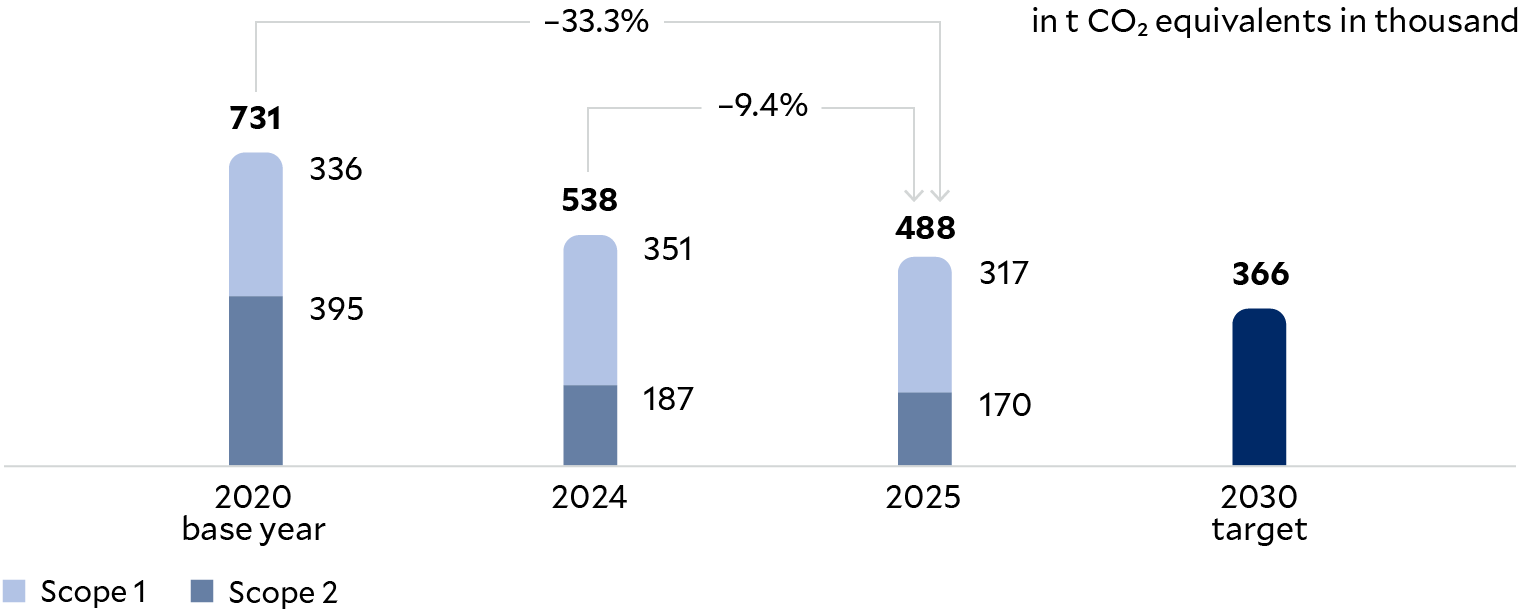
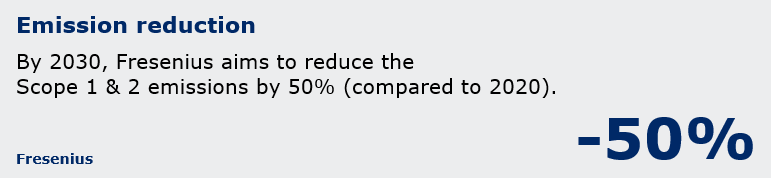
We want to live up to our responsibilities and reduce our greenhouse gas emissions step by step. By 2030, we aim to reduce our Scope 1 and Scope 2 emissions by 50% compared to our 2020 base year.
Scope 1 and Scope 2 target pathway to 2030
The decarbonization of our value chain is an important part of our long-term journey toward net zero emissions. Scope 3 emissions arise indirectly across our upstream and downstream value chain, for example through purchased raw materials or the treatment of sold products at the end of their life cycle. As the majority of our emissions occur along the value chain, we work with our suppliers to help reduce these emissions.
Climate change is also a health issue. Rising temperatures, more frequent heatwaves and changing weather patterns directly affect people's health, particularly vulnerable groups such as the elderly, chronically ill, and children. Heat stress can lead to circulatory problems, dehydration and an increased risk of death. At the same time, changing climatic conditions can contribute to the spread of infectious diseases and enable their vectors to spread into new regions. . For us as a healthcare company, the impacts of climate change on human health and healthcare delivery are therefore particularly relevant. We see reducing greenhouse gas emissions and ensuring reliable healthcare delivery as closely connected.
Further information on our 2030 climate targets and their implementation can be found in our Sustainability Statement:
➔ Read more in our Sustainability Statement.
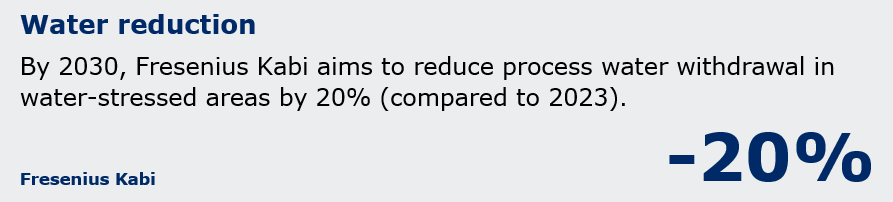
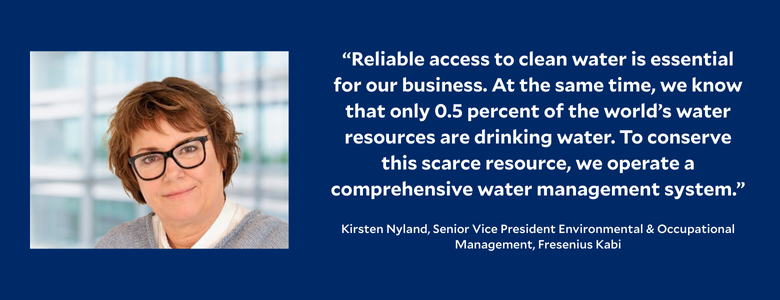
Water at Fresenius means using water responsibly and preserving water quality, with a particular focus on reducing water withdrawal in water-stressed areas.
Water is one of our most valuable resources. As a healthcare company, we are dependent on water: We need drinking water of the highest quality to ensure safe patient care. It is crucial for hygiene and well-being. We also use water in the production of our pharmaceutical products – as process water as well as product component. The quality requirements for this water are even higher than those for drinking water.
We aim to minimize the impacts of our business activities on water resources and the receiving systems into which we discharge our wastewater, and to manage water and wastewater responsibly. We place particular focus on sites in water-stressed areas, where reducing water withdrawal is especially important.
Circularity & Waste at Fresenius means using resources more efficiently by embedding circular principles into our products, processes, waste management and value chains.
We are committed to conserving natural resources wherever possible. As a healthcare company, we must always strike a balance between resource efficiency, hygiene requirements, patient safety and product quality.
Disposable items are often used in clinics for hygienic reasons. Our options for saving resources are limited here. There are also strict regulations for pharmaceutical packaging. Our most important levers for conserving resources are therefore developing durable and resource-saving products, reusing resources wherever possible, and disposing of waste safely and systematically.
Sustainability Insights
Explore our stories to learn what sustainability looks like in our daily operations:
-
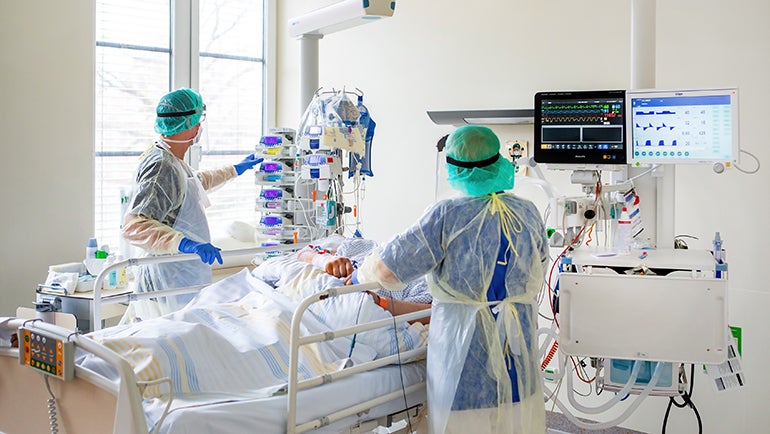
Resistant pathogens: Prevention in hospitals and when manufacturing antibiotics
Antibiotics play a key role in modern medicine. They treat bacterial infections and prevent them from spreading. In certain cases, however, their reliability can no longer be relied upon. That’s because antimicrobial resistance – the incidence of resistant pathogens – is spreading worldwide.
-
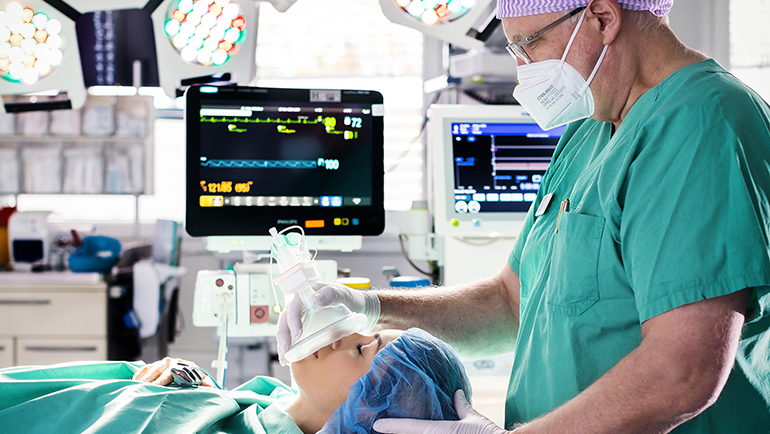
What do anesthetic gases have to do with the climate?
Anesthetic gases are an indispensable part of modern medicine. At the same time, they represent one of the largest direct sources of emissions in hospital operations, with their global warming potential exceeding that of CO2 many times over. Thanks to modern medical technology, special systems can be used to capture anesthetic gases instead of releasing them unimpeded into the atmosphere.
-
Enhancing patient experience: Bridging digital care and energy consumption
Enhancing patient experience is one of Fresenius’ top priorities – and digitalization plays an important role in achieving this. In 2025, Quirónsalud launched a pilot project at a hospital in Southern Spain to connect our digital platform Casiopea with the hospital’s Building Management System.