Neonatology
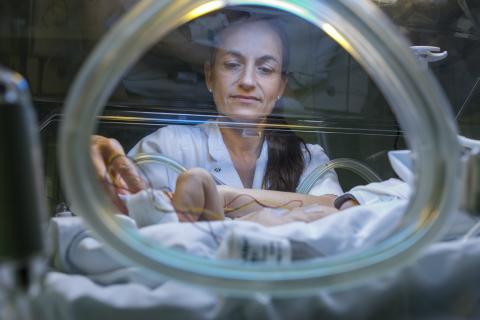
Doctor and premature baby on the neonatology ward of the Quirónsalud Clinic in Barcelona.
Fresenius is reorganizing the Group’s inpatient rehabilitation business, to create the conditions for the continued growth of Fresenius Helios and Fresenius Vamed. On July 1, 2018, 38 health care facilities and 13 service companies in Germany specializing in inpatient post-acute and nursing care, which are now operated by Fresenius Helios, will be transferred to Fresenius Vamed. This will strengthen Fresenius Vamed’s position as a leading provider of post-acute care in Europe. Fresenius Helios, meanwhile, will focus even more strongly on the acute care hospital business and its continued internationalization.
The transaction has a total volume of €485 million, including assumed net debt of €15 million. It will be financed Group-internally. This year, the inpatient post-acute care business that is being transferred is expected to generate about €460 million in sales and an EBIT of around €37 million.
As part of the transfer, Fresenius Vamed is taking on all of the approximately 7,700 employees of the post-acute care business.
With regard to the respective core competencies of Fresenius Vamed and Fresenius Helios, the two Fresenius business segments will further intensify their cooperation, which has already proven successful in Germany and Spain.
Stephan Sturm, CEO of Fresenius, said: “For Fresenius, post-acute care is and will remain an important component of the treatment we provide to our patients. And now by bundling our great expertise in this area within Fresenius Vamed, we are building a platform for further international growth. We are also putting Fresenius Helios’ on a stronger growth footing, with an even clearer focus on acute care. In addition, we are facilitating even more intensive cooperation between these two business segments, for the benefit of our patients.”
Fresenius Vamed is already a leading post-acute care provider in Austria, Switzerland and the Czech Republic, and entered the British market last year. After the transaction, Fresenius Vamed will have a total of 63 inpatient health care facilities in five European countries.
Even after the transfer of its inpatient post-acute care business to Fresenius Vamed, Fresenius Helios will remain Europe’s largest private hospital operator, with 137 hospitals and about 100,000 employees in Germany and Spain. The strategic focus of Fresenius Helios will remain its acute care hospitals, as well as the outpatient acute care - including preventative medicine - and outpatient post-acute care.
As a consequence of the transfer, Fresenius is adjusting the 2018 outlook for Fresenius Helios and Fresenius Vamed. Fresenius Helios now expects EBIT growth of 5% to 8% (7% to 10% previously). Its organic sales growth outlook of 3% to 6% remains unchanged. Fresenius Vamed is now expecting EBIT growth of 32% to 37%1 (5% to 10% previously). Fresenius Vamed’s organic sales growth forecast remains unchanged at 5% to 10%.
The transaction will not significantly affect the 2018 business results of the Fresenius Group, which accordingly confirms its guidance2 for the current business year. Group sales are expected to increase by 5% to 8%3 in constant currency. Net income4,5 is expected to grow by 6% to 9% in constant currency. Excluding expenditures for the further development of the biosimilars business, net income4,6 is expected to grow by ~10% to 13% in constant currency.
1 Expected EBIT of the inpatient post-acute care business in H2/2018: ~€20 million
2 Excluding effects of the Akorn, NxStage and Sound Physicians transactions
3 2017 base adjusted for IFRS 15 adoption (deduction of €486 million at Fresenius Medical Care)
4 Net income attributable to shareholders of Fresenius SE & Co. KGaA
5 2017 base: €1,816 million; 2018 before special items (i.e., transaction-related effects); including expenditures for further development of biosimilars business (€43 million after tax in FY/17 and ~€120 million after tax in FY/18)
6 2017 base: €1,859 million; 2018 before special items (i.e., transaction-related effects)
This release contains forward-looking statements that are subject to various risks and uncertainties. Future results could differ materially from those described in these forward-looking statements due to certain factors, e.g. changes in business, economic and competitive conditions, regulatory reforms, results of clinical trials, foreign exchange rate fluctuations, uncertainties in litigation or investigative proceedings, and the availability of financing. Fresenius does not undertake any responsibility to update the forward-looking statements in this release.
Jiménez Díaz Foundation University Hospital in Madrid has again been awarded the EFQM Recognized for Excellence award with the maximum five stars, this time also receiving the highest rating of any hospital in Spain. The 667-bed facility earned more than 650 points on the rating scale used by the European Foundation for Quality Management during a comprehensive management and process evaluation earlier this year. In the award presentation, the EFQM cited Jiménez Díaz Foundation University Hospital’s intensive focus on patient care, as well as its continuous improvements in treatments and the use of medical technology. This leading teaching hospital is part of the Quirónsalud group, the Spanish unit of Fresenius Helios.
Quirónsalud Tenerife Hospital has opened a new intensive care unit, equipped with the latest medical equipment for treating as many as six critically ill patients at a time. Quirónsalud, the Spanish hospital group that is part of Fresenius Helios, invested more than €1 million in the 400-square-meter (4,300-square-foot) ICU.
Doctor and premature baby on the neonatology ward of the Quirónsalud Clinic in Barcelona.
Fresenius Helios recently opened a 130-bed building at the company’s hospital in Dachau, a city near Munich. The new structure is part of a €55 million renovation and expansion program that will include a modernization of the existing hospital building over the next two years. Meanwhile, in the northern German city of Nienburg/Weser, work has started on a building that will almost double the size of the emergency department at Fresenius Hospital Mittelweser. About €2.3 million is being invested in this project, which is scheduled for completion in the autumn.
Fresenius Helios has presented the new Helios Science Prize for outstanding research by employees that contributes to improved treatment quality. The three winners all work at hospitals in Germany and were honored for their work in different areas of medicine. The prize, which comes with a cash award, went to Dr. Jitka Veldema of Helios Hospital Kipfenberg (for her work on stroke rehabilitation), Prof. Dr. Alexander Kreuter of Helios St. Elisabeth Hospital in Oberhausen (cancer diagnosis in HIV patients), and Dr. Patrick Weil of Helios University Hospital in Wuppertal (testicular cancer therapy).