

A Conversation with Tim Schleifenecker: Embedding Human Rights Standards in Everyday Hospital Operations
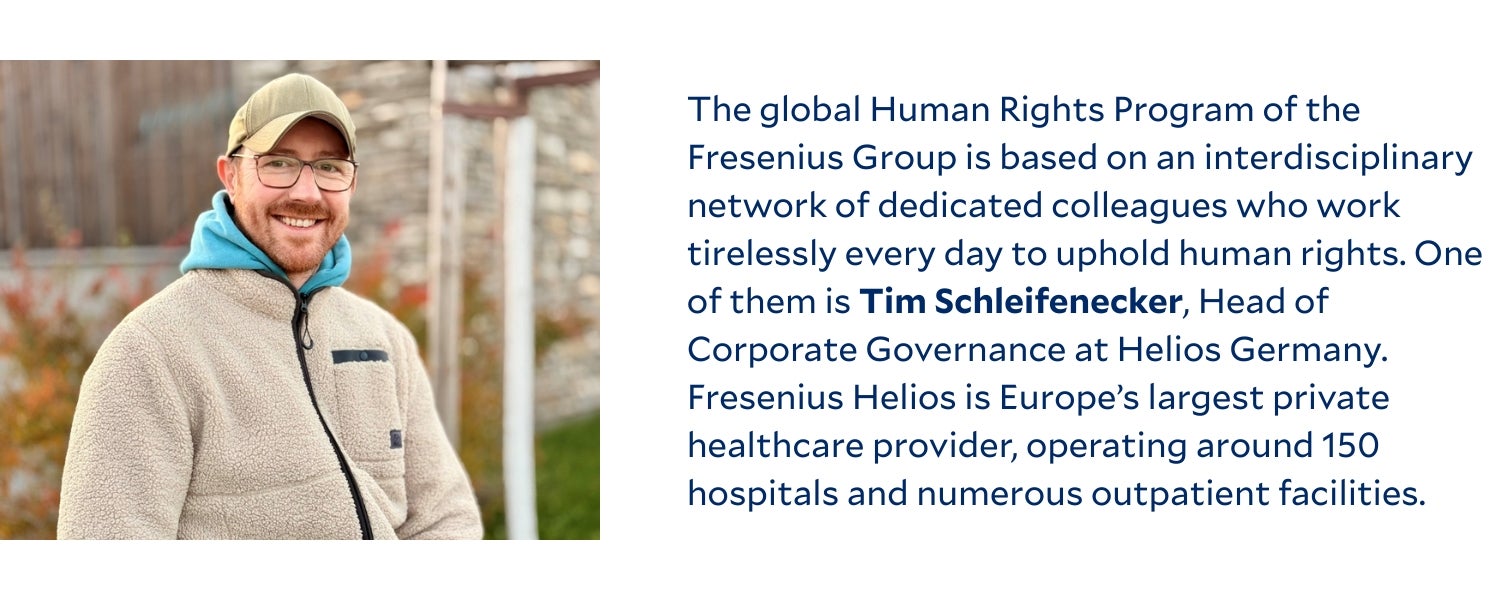
Question: Mr. Schleifenecker, how does Helios Germany integrate human rights standards into everyday hospital operations? And how do you ensure that these standards are upheld by all employees and partners within the hospital network?
Tim Schleifenecker: At Helios Germany, human rights standards are firmly embedded in day-to-day hospital operations. We achieve this by incorporating human rights considerations into all of our binding policies. Regular training and awareness-raising initiatives complement this system and form an integral part of our efforts to promote the topic. In addition, we work closely with our partners in hospital operations and actively involve them in our requirements. Compliance with these standards is continuously monitored through internal reviews and control mechanisms to ensure that our expectations are met.
Question: As Head of Corporate Governance, you are responsible for both the Internal Control System (ICS) and the topic of human rights, as well as other governance areas. What synergies arise from this?
Tim Schleifenecker: Our human rights program and the Internal Control System complement each other perfectly. The ICS is a central component of our risk management system and includes a comprehensive set of internal controls to ensure compliance with operational and legal standards and to manage risks. Together, the two systems enable us to identify, assess, and address risks at an early stage.
This synergy not only strengthens compliance but also fosters a culture of accountability and respect within our hospitals. For example, risks identified through the human rights program can be quickly addressed through the Internal Control System using relevant control mechanisms, allowing us to manage human rights risks more effectively. The close integration of both systems also enables us to advance related topics in parallel and jointly address them with hospital management teams.
Question: How does Helios Germany embed respect for human rights in everyday hospital operations, and what challenges do you face?
Tim Schleifenecker: In principle, respect for human rights already holds a very high value in the hospital environment at Helios Germany – after all, our work is about people’s health. That said, it can sometimes be challenging to communicate the relevance of human rights to employees’ daily work. However, we have had very positive experiences in our hospitals and central functions when engaging in open dialogue about these topics. Beyond legal obligations, we make Fresenius’s and Helios Germany’s stance very clear: we are committed to respecting human rights.
Another key challenge lies in aligning our human rights commitments with the complex and dynamic nature of hospital operations. Time pressure, competing priorities, or economic challenges can sometimes make implementation difficult. Our strategy, therefore, is to empower employees to act responsibly and understand the purpose behind these efforts – through clear and efficient processes, targeted training, and open communication.
We rely on close collaboration and ongoing dialogue to develop practical solutions that strengthen both hospital operations and human rights in the long term. It is always rewarding to see employees reach out to us with relevant questions – because that is when you know that the commitment to human rights is truly being lived.
Contact
Fresenius SE & Co. KGaA
Else-Kröner-Str. 1
61352 Bad Homburg
Germany
humanrights@fresenius.com
Would you like to make a contribution?
Are you familiar with our core human rights principles? If not, we encourage you to review our Human Rights Statement and Group Policy on Labor and Social Standards to learn more about our commitments.
If you become aware of any potential violation of our ethical principles, please report it — either anonymously through our grievance mechanism or directly to the Integrity or Human Rights teams.