
A Conversation with Sabine Schmitt and Lisa Armbruster: On Human Rights Risks and Responsibility Within Our Own Operations
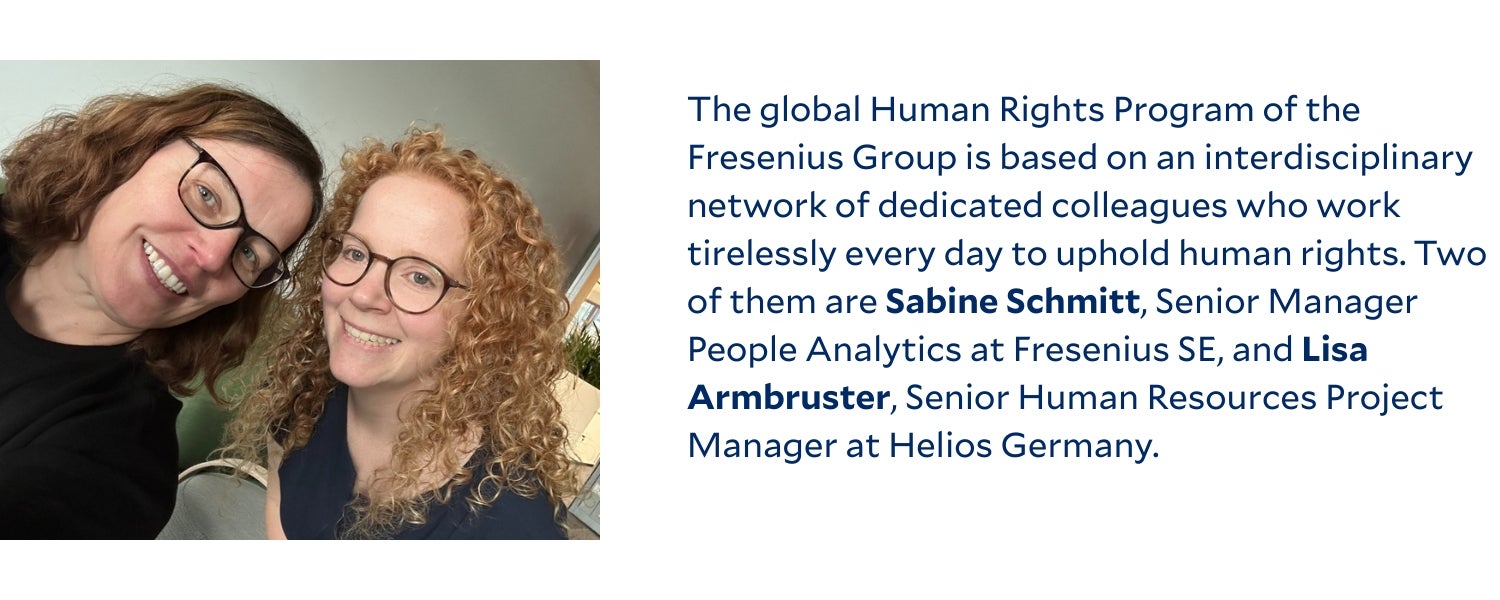
Question: Ms. Armbruster, as a global healthcare group, we have standards and processes in place to ensure respect for human rights. Are there still risks – and if so, what kind?
Lisa Armbruster: Yes, despite our high standards, we identify potential human rights risks as part of our regular risk analyses. In doing so, we follow national and international procedures and guidelines for human rights due diligence. In the past, we have defined occupational safety and health at work as priority risk areas. But we also see the need for action across the Group on people-related issues such as discrimination and unequal treatment.
Question: Ms. Schmitt, what happens when you identify potential risks within your own operations?
Sabine Schmitt: In such cases, we take targeted preventive measures that are tailored to the specific issue. At the same time, we rely on proven standard measures, including our binding Code of Conduct, our Group Social and Labor Standards Guideline, and our management systems for occupational health and safety.
Raising awareness among our employees is also very important to us: training on human rights topics and communication initiatives related to our Human Rights Statement help to strengthen awareness. After all, everyone can contribute – for example, by familiarizing themselves with our Human Rights Statement or by reporting suspected cases.
Ms. Armbruster, how do you ensure compliance with human rights standards specifically in human resources?
Lisa Armbruster: We seek to make sure that our human resources processes worldwide are designed in line with our human rights commitment, for example, through standardized policies, training programs, and a strong internal control system. In addition, we promote a culture of open dialogue. Employees should feel safe to raise concerns – whether through our established grievance mechanism or in direct conversations with our human resources or Integrity teams.
Ms. Schmitt, one identified risk area that you also reported in the 2024 Sustainability Report under the EU CSRD relates to remuneration. How do you ensure that pay across the Group is fair and compliant with legal requirements?
Sabine Schmitt: All local compensation practices must comply with the applicable minimum wage regulations. Responsibility for compliance lies with the local human resources teams, which conduct regular reviews, especially in markets with high inflation or economic instability. Our global human resources organization supports this through centralized monitoring based on data from our global human resources system.
If deviations occur, clearly defined escalation processes apply. For example, in 2024 we identified a case in which three employees were temporarily paid below the statutory minimum wage due to hyperinflation. Their salaries were immediately adjusted, including retroactive corrections. To prevent such situations in the future, our local human resources teams in countries with high inflation dynamics are required to review salary levels at least twice a year against the statutory minimum requirements.
Contact
Fresenius SE & Co. KGaA
Else-Kröner-Str. 1
61352 Bad Homburg
Germany
humanrights@fresenius.com
Would you like to make a contribution?
Are you familiar with our core human rights principles? If not, we encourage you to review our Human Rights Statement and Group Policy on Labor and Social Standards to learn more about our commitments.
If you become aware of any potential violation of our ethical principles, please report it — either anonymously through our grievance mechanism or directly to the Integrity or Human Rights teams.