

-
Underlying business development in line with expectation
-
Continued strong organic revenue growth
-
Healthy growth in the U.S. dialysis business
-
Negative effect from ESCOs, based on recent reports for prior plan years
-
Increasing earnings growth momentum expected
-
Outlook 2019 confirmed
Rice Powell, Chief Executive Officer of Fresenius Medical Care, said: “We have delivered a solid second quarter with continued strong organic revenue growth. Net income in our underlying dialysis business developed in line with our expectations. We are confident to accelerate earnings growth over the second half of the year toward achieving our full-year targets. Due to ongoing delays in reconciliation of generated savings in the value-based ESCO pilot program and differing views with regard to the measurement mechanisms, it is prudent to adjust the rate of savings we applied to accrue revenues and earnings. While views differ on the magnitude of savings generated, it is clear that we have realized meaningful savings in the ESCO pilot as well as other value-based arrangements. We moved quickly and maintained tremendous focus since 2014. We are uniquely positioned with our vast experience to impact cost and quality of care in kidney disease. We remain committed to value-based care.”

1 For a detailed reconciliation, please refer to the table at the end of the press release
2 Net income attributable to shareholders of Fresenius Medical Care AG & Co. KGaA
Home dialysis strategy reinforced by President Trump’s Executive Order
Fresenius Medical Care continues to achieve an increase in the number of treatments being carried out in the home setting in North America. The investments in training facilities, education and distribution are important areas of investments this year. Concurrently, the company is investing around EUR 100 million in 2019 as part of the Cost Optimization Program to optimize its US services footprint. The company´s execution of its home strategy is additionally supported by the Executive Order on Advancing Kidney Health. Fresenius Medical Care has intensified its initiatives to promote home dialysis, improve access to transplants, and develop value-based care models for chronic kidney disease patients.
Continued strong organic growth
Revenue in the second quarter 2019 increased by 3% to EUR 4,345 million (stable at constant currency). Organic growth continued to be strong at 4%. Adjusted for the Q2 2018 revenue contribution from Sound Inpatient Physicians (“Sound”, divested effective end of Q2 2018) as well as the impact from the IFRS 16 implementation and the revenue contribution from NxStage, revenue increased by 8% (+5% at constant currency).
Health Care Services revenue increased by 2% to EUR 3,455 million ( 2% at constant currency). Growth was constrained by missing revenue from the divested Sound activities and closed or sold clinics. Growth in same market treatments (volume growth), acquisitions and increases in organic revenue per treatment had a positive impact. Health Care Products revenue increased by 7% to EUR 890 million (+6% at constant currency), mainly driven by higher sales of home hemodialysis products (supported by the acquisition of NxStage), products for acute care treatments, peritoneal dialysis products, and renal pharmaceuticals, partially offset by lower sales of machines as a result of changes in the accounting treatment for sale-leaseback transactions due to the IFRS 16 implementation and in EMEA lower sales of dialyzers.
In the first half 2019, revenue increased by 4% to EUR 8,478 million (-1% at constant currency). Excluding the effects from Sound, the IFRS 16 implementation and NxStage, revenue was up by 9% (+5% at constant currency). Organic growth was 5%. Health Care Services revenue grew by 3% (-2% at constant currency). Health Care Products revenue increased by 7% (+5% at constant currency).
In the second quarter 2019 total EBIT decreased by 63% to EUR 521 million (-65% at constant currency), resulting in an operating income margin of 12.0% (compared to 33.3% in the previous year). The strong result in the previous year was driven by the gain related to divestitures of Care Coordination activities. On an adjusted basis, EBIT decreased by 12% to EUR 491 million (-17% at constant currency) and operating income margin decreased from 14.1% to 11.5% driven by higher personnel expense and the reduction in patient attribution and a decreasing savings rate for ESCOs, based on recent reports for prior plan years (“ESCO effect”).
In the first half 2019, EBIT decreased by 44% to EUR 1,058 million (-47% at constant currency). Adjusted for the effects described above, EBIT decreased by 2% (-7% at constant currency).
Net income2 decreased by 74% to EUR 254 million (-76% at constant currency) in the second quarter 2019. On an adjusted basis, net income2 decreased by 9% (-14% at constant currency).
Based on approximately 303.5 million shares (weighted average number of shares outstanding), basic earnings per share (EPS) decreased by 74% to EUR 0.84 ( 76% at constant currency). On an adjusted basis, basic EPS amounted to EUR 0.92, representing a decrease of 9% (-14% at constant currency).
Strong Dialysis Care Growth
In the second quarter 2019 North America revenue, which represents 70% of total revenue, increased by 3% to EUR 3,061 million (-3% at constant currency). Organic growth in North America was 4%. Health Care Services revenue increased by 1% to EUR 2,789 million (-5% at constant currency). Dialysis Care revenue increased by 13% (6% at constant currency) to EUR 2,511 million. The growth was mainly due to increases in same market treatments (volume growth), increases in organic revenue per treatment, and contributions from acquisitions, partially offset by the effect of closed or sold clinics. Same-market treatment growth in the US again accelerated and reached 4.1%. Care Coordination revenue decreased by 47% to EUR 278 million (-50% at constant currency), mainly due to the divestiture of Sound in the previous year.

In the U.S., the average revenue per treatment increased by USD 4 to 358 USD (+1%). The development was mainly attributable to higher utilization of oral based ancillaries and an increase in the ESRD PPS base rate, partially offset by lower revenue from commercial payors.
Cost per treatment in the U.S., adjusted for the implementation of IFRS 16, increased from USD 289 to USD 297. This increase was largely driven by higher personnel expense as well as increased costs for occupancy and health care supplies.
Health care product revenue increased by 29% to EUR 272 million (+21% at constant currency), driven by higher sales of home hemodialysis products supported by the NxStage acquisition, renal pharmaceuticals and peritoneal dialysis products, partially offset by lower sales of machines as a result of changes in the accounting treatment for sale-leaseback transactions due to the IFRS 16 implementation.
Total EBIT of the North America segment decreased by 67% to EUR 429 million (-68% at constant currency). The strong results in the previous year were mainly driven by the gain related to the divestiture of Care Coordination activities. The operating income margin sequentially improved from 12.9% in the first quarter 2019 to 14.0% in the second quarter of 2019. The dialysis operating income margin decreased period over period by 1.7 percentage points to 15.4%. This was driven by higher personnel expense, the integration and operational costs associated with NxStage and the prior year income attributable to a consent agreement on certain pharmaceuticals, partially offset by higher utilization of oral based ancillaries with favorable margins and a positive effect from the IFRS 16 implementation.
In the first half 2019, North America revenue increased by 4% to EUR 5,948 million (-3% at constant currency). Adjusted for the H1 2018 revenue contribution from Sound as well as the impact from IFRS 16 and NxStage, revenue grew by 12% (5% at constant currency). Mainly driven by the gain related to divestitures of Care Coordination activities in the previous year as well as higher personnel expenses, integration and operational costs associated with NxStage and the ESCO effect, partially offset by higher utilization of oral based ancillaries with favorable margins, the operating income margin decreased from 28.7% in the first half 2018 to 13.5% in the first half 2019.
As of the end of June 2019, the company was treating 208,019 patients (+4%) at its 2,583 clinics (+6%) in North America. Dialysis treatments increased by 4%.
In the second quarter 2019 EMEA revenue decreased by 1% to EUR 648 million (stable at constant currency), driven by a positive business development in Health Care Services, offset by lower sales of Health Care Products. Health Care Service revenue increased by 6% (+7% at constant currency) as a result of growth in same market treatments, contributions from acquisitions, and increases in organic revenue per treatment, partially offset by the effect of closed or sold clinics. Health Care Product revenue decreased by 7% (-7% at constant currency). Dialysis product revenue decreased by 7% (-7% at constant currency) due to lower sales of dialyzers, bloodlines, hemodialysis solutions and concentrates and machines mainly in North Africa and the Middle East.
Non-Dialysis product revenue decreased by 8% to EUR 17 million (-8% at constant currency) from EUR 18 million.
EBIT decreased by 8% to EUR 96 million (-8% at constant currency). The operating income margin was 14.9% in the second quarter 2019, a decrease of 1.2% from the second quarter 2018, mainly driven by lower product sales, an unfavorable impact from an inventory revaluation, higher personnel expense in certain countries and unfavorable foreign currency transaction effects, partially offset by higher other income related to a favorable outcome in a legal proceeding, a favorable impact from acquisitions and a positive effect from the IFRS 16 implementation.
In the first half 2019, EMEA revenue increased by 1% (+2% at constant currency) to EUR 1,301 million, while EBIT of EUR 235 million was up by 9% (+10% at constant currency). The improved profitability was mainly driven by a reduction of a contingent consideration liability related to Xenios in the first quarter of 2019.
As of the end of June 2019, the company was treating 65,871 patients (+4%) at its 783 dialysis clinics (+3%) in the EMEA region. Dialysis treatments increased by 4%.
In the second quarter 2019 Asia-Pacific revenue increased by 8% to EUR 458 million (+7% at constant currency), driven by a positive business development in both Health Care Services and Health Care Products. Organic growth was 7%. Health Care Services revenue increased by 10% to EUR 210 million (+7% at constant currency). Dialysis Care revenue increased by 8% to EUR 153 million (+4% at constant currency), mainly as a result of growth in same market treatments and contributions from acquisitions, partially offset by missing contributions from closed or sold clinics and a decrease in organic revenue per treatment. Care Coordination revenue increased by 16% to EUR 57 million (+15% at constant currency). The revenue growth was driven by contributions from acquisitions and organic revenue growth. Health Care Product revenue increased by 7% (+7% at constant currency) resulting from increased sales of dialyzers, products for acute care treatments, bloodlines, hemodialysis solutions and concentrates as well as machines.
An important area of investments of Fresenius Medical Care in 2019 is the expansion of production capacities and the ramp up of the dialysis services business in China to capture the growing demand in the country with the most dialysis patients worldwide. As part of the 2019 investment initiatives this impacts, as expected, the earnings growth in the region.
EBIT decreased by 11% (-12% at constant currency) to EUR 69 million. The resulting operating income margin was 15.1% (Q2 2018: 18.4%) due to an unfavorable impact from growth in lower margin businesses and unfavorable foreign currency transaction effects, partially offset by a positive effect from the IFRS 16 implementation.
In the first half 2019, Asia-Pacific revenue increased by 9% to EUR 886 million (+6% at constant currency). Operating income increased by 8% to EUR 164 million (+6% at constant currency).
As of the end of June 2019, the company was treating 31,845 patients (+4%) at its 399 clinics (+4%) in the Asia-Pacific region. Dialysis treatments increased by 4%.
In the second quarter 2019 Latin America revenue increased by 5% to EUR 172 million (+26% at constant currency). Organic growth was 24%. Health Care Services revenue increased by 2% to EUR 121 million (+28% at constant currency). The increase at constant currency was mainly a result of increases in organic revenue per treatment, contributions from acquisitions and growth in same market treatments, partially offset by the effect of closed or sold clinics.
Health Care Product revenue increased by 14% (20% at constant currency), mainly driven by increased sales of machines, peritoneal dialysis products, hemodialysis solutions and concentrates.
EBIT decreased by 47% to EUR 6 million (-81% at constant currency). The operating income margin was 3.4% (Q2 2018: 6.8%). The decline was mainly driven by hyperinflation in Argentina.
In the first half 2019, Latin America revenue was stable at EUR 334 million (an increase of 20% at constant currency). Operating income decreased by 32% (-49% at constant currency) to EUR 17 million. The operating income margin decreased from 6.8% to 3.4%, mainly driven by hyperinflation in Argentina.
As of the end of June 2019, the company was treating 33,815 patients (+7%) at its 231 clinics (-1%) in the Latin America region. Dialysis treatments increased by 5%.
Net interest expense increased in the second quarter by 35% to EUR 114 million (+30% at constant currency). The increase was primarily due to the IFRS 16 implementation and a higher debt level, partially offset by the replacement of high interest bearing senior notes repaid in 2018 by debt instruments at lower interest rates. Income tax expense significantly decreased by 65% to EUR 92 million for the second quarter of 2019, which translates into an effective tax rate of 22.7% (Q2 2018: 19.8%), driven by the prior year impacts from the gain related to the divestiture of Care Coordination activities as well as favorable implications of the US Tax Reform.
Strong cash-flow development
In the second quarter 2019 the company generated EUR 852 million of operating cash flow (Q2 2018: EUR 656 million). This corresponds to 19.6% of revenue (Q2 2018: 15.6%). The increase was largely driven by the IFRS 16 implementation leading to a reclassification of the repayment portion of rent to financing activities. The number of days sales outstanding (DSOs) improved to 77 days (June 30, 2018: 82 days). Free cash flow (net cash used in operating activities, after capital expenditures, before acquisitions and investments) amounted to EUR 559 million (Q2 2018: EUR 429 million). Free cash flow was 12.9% of revenue (Q2 2018: 10.2%).
Outlook confirmed3,4
For 2019, Fresenius Medical Care expects adjusted revenue to grow between 3% and 7% and adjusted net income2 to develop in the range of -2% to 2%.
For 2020, Fresenius Medical Care expects adjusted revenue as well as adjusted net income to grow at a mid to high single digit rate.
In order to make the business performance in the respective periods comparable these targets as well as the 2018 base are and will be adjusted for items such as: FCPA related charges, the IFRS 16 implementation, the contributions from Sound in the first half 2018, the gain (loss) related to divestitures of Care Coordination activities and expenses for the implementation of the cost optimization program. All effects from the acquisition of NxStage Medical Inc. are excluded from the targets for 2019 and 2020.
3 Numbers at constant currency
4 Reported revenue 2018 of EUR 16,547 million adjusted for Sound H1 2018; reported net income 2018 of EUR 1,982 million adjusted for Sound H1 2018, the gain (loss) related to divestitures of Care Coordination activities and the 2018 FCPA related charge
Number of employees increased
As of June 30, 2019, Fresenius Medical Care had 119,631 employees (full-time equivalents) worldwide, compared to 111,263 employees as of June 30, 2018. This increase of 8% was mainly attributable to the NxStage acquisition.
Conference call
Fresenius Medical Care will host a conference call to discuss the results of the second quarter today at 3:30 p.m. CEDT / 9:30 a.m. EDT. Details will be available on the company’s website. A replay will be available shortly after the call.
Please refer to the PDF for a complete overview of the results for the second quarter 2019.
Disclaimer: This release contains forward-looking statements that are subject to various risks and uncertainties. Actual results could differ materially from those described in these forward-looking statements due to various factors, including, but not limited to, changes in business, economic and competitive conditions, legal changes, regulatory approvals, results of clinical studies, foreign exchange rate fluctuations, uncertainties in litigation or investigative proceedings, and the availability of financing. These and other risks and uncertainties are detailed in Fresenius Medical Care AG & Co. KGaA's reports filed with the U.S. Securities and Exchange Commission. Fresenius Medical Care AG & Co. KGaA does not undertake any responsibility to update the forward-looking statements in this release.
- Good organic sales growth across all business segments
- Growth investments well on track
- Fresenius Kabi successfully launched first biosimilar in Europe; continued excellent growth in Emerging Markets
- Fresenius Helios showing strong organic sales growth in Germany and enters successfully Colombian hospital market
- Fresenius Medical Care’s strategy reinforced by U.S. government’s plans for changes of kidney disease care
If no timeframe is specified, information refers to Q2/2019

1 Adjusted for IFRS 16 effect
2 Q2/18 and H1/18 adjusted for divestitures of Care Coordination activities at Fresenius Medical Care (FMC)
3 Net income attributable to shareholders of Fresenius SE & Co. KGaA
For a detailed overview of special items and adjustments please see the reconciliation tables on pages 20-32 of the PDF document.
Stephan Sturm, CEO of Fresenius, said: “We are reporting a good second quarter 2019, with healthy organic growth in all four business segments. Our investments in future growth are moving ahead according to plan, as we further strengthen the foundations for the long-term, successful development of Fresenius. So we are very confident about the second half and the coming years.”
Group sales growth guidance for 2019 raised
Based on the Group’s good H1/19 results and good prospects for the remainder of the year, Fresenius raises its 2019 Group sales growth guidance. Fresenius now projects sales growth1 of 4% to 7% in constant currency. Previously, Fresenius expected sales growth1 of 3% to 6% in constant currency. The company confirms its earnings guidance. Net income2,3 growth is expected to be ~0% in constant currency. The guidance for 2019 includes the related sales and dilutive earnings contributions of the NxStage acquisition.
Fresenius expects net debt/EBITDA4 at year-end to be around the upper-end of the original self-imposed target corridor of 2.5x to 3.0x. This includes the NxStage acquisition which is increasing the net debt/EBITDA ratio in 2019 by ~30 basis points and excludes IFRS 16 effects.
Due to the adoption of the IFRS 16 accounting standard (“IFRS 16 effect”), Fresenius’ self-imposed target corridor has shifted to 3.0x to 3.5x net debt/EBITDA on a reported basis.
1 On a comparable basis: FY/18 base: €33,009 million; FY/18 adjusted for divestitures of Care Coordination activities at FMC (H1/18); FY/19: adjusted for IFRS 16 effect
2 Net income attributable to shareholders of Fresenius SE & Co. KGaA
3 On a comparable basis: FY/18 base: €1,872 million; FY/18 before special items and adjusted for divestitures of Care Coordination activities at FMC (H1/18); FY/19: before special items (transaction-related expenses, revaluations of biosimilars contingent liabilities, gain related to divestitures of Care Coordination activities at FMC, expenses associated with the cost optimization program at FMC), adjusted for IFRS 16 effect
4 Both net debt and EBITDA calculated at expected annual average exchange rates; excluding further potential acquisitions
For a detailed overview of special items and adjustments please see the reconciliation tables on pages 20-32 of the PDF document.
6% sales growth1 in constant currency
Group sales were €8,761 million including an IFRS 16 effect of -€18 million. Group sales1 on a comparable basis increased by 8% (6% in constant currency) to €8,779 million (Q2/18: €8,124 million). Organic sales growth was 5%. Acquisitions/divestitures contributed net 1% to growth. In H1/19, Group sales were €17,256 million including an IFRS 16 effect of -€40 million. Group sales1 on a comparable basis increased by 8% (6% in constant currency) to €17,296 million (H1/18: €15,994 million). Organic sales growth was 5%. Acquisitions/divestitures contributed net 1% to growth. Positive currency translation effects of 2% were mainly driven by the U.S. dollar strengthening against the euro.
Net income2,3 growth in constant currency
Group EBITDA before special items was €1,703 million including an IFRS 16 effect of €242 million. Group EBITDA2 on a comparable basis decreased by 2% (-5% in constant currency) to €1,461 million (Q2/18: €1,495 million). In H1/19, Group EBITDA before special items was €3,404 million including an IFRS 16 effect of €462 million. Group EBITDA2 on a comparable basis increased by 2% (-1% in constant currency) to €2,942 million (H1/18: €2,889 million).
Group EBIT before special items was €1,118 million including an IFRS 16 effect of €37 million. Group EBIT2 on a comparable basis decreased by 5% (-7% in constant currency) to €1,081 million (Q2/18: €1,135 million). The EBIT margin2 on a comparable basis was 12.3% (Q2/18: 14.0%). A significant contributor was the reduction in patient attribution and a decreasing savings rate for ESCOs, based on recent reports for prior plan years (“ESCO effect”). Reported Group EBIT4 was €1,118 million. In H1/19, Group EBIT before special items was €2,248 million including an IFRS 16 effect of €56 million. Group EBIT2 on a comparable basis remained at previous year’s level (-3% in constant currency) at €2,192 million (H1/18: €2,185 million). The EBIT margin2 on a comparable basis was 12.7% (H1/18: 13.7%). Reported Group EBIT4 was €2,233 million.
Group net interest before special items was -€180 million including an IFRS 16 effect of -€58 million. On a comparable basis, net interest2 improved to -€122 million (Q2/18: -€140 million) mainly due to successful refinancing activities and lower interest rates. Reported Group net interest4 was -€179 million. In H1/19, Group net interest before special items was -€361 million including an IFRS 16 effect of -€106 million. On a comparable basis, net interest1 improved to -€255 million (H1/18: -€279 million). Reported Group net interest3 was -€363 million.
1 On a comparable basis: Q2/18 and H1/18 adjusted for divestitures of Care Coordination activities at FMC;
Q2/19 and H1/19 adjusted for IFRS 16 effect
2 On a comparable basis: Q2/19 and H1/19 before special items and adjusted for IFRS 16 effect;
Q2/18 and H1/18 adjusted for divestitures of Care Coordination activities at FMC
3 Net income attributable to shareholders of Fresenius SE & Co. KGaA
4 After special items and including IFRS 16 effect
For a detailed overview of special items and adjustments please see the reconciliation tables on pages 20-32 of the PDF document.
The Group tax rate before special items and adopting IFRS 16 was 22.8%. Group tax rate1 on a comparable basis was 22.8% (Q2/18: 23.3%). In H1/19, the Group tax rate before special items and adopting IFRS 16 was 23.1%. In H1/19, Group tax rate1 on a comparable basis was 23.1% (H1/18: 22.1%).
Noncontrolling interest before special items was €253 million including an IFRS 16 effect of €7 million. Noncontrolling interest1 on a comparable basis was €260 million (Q2/18:
€290 million). In H1/19, Noncontrolling interest before special items was €524 million including an IFRS 16 effect of €20 million. Noncontrolling interest1 on a comparable basis was €544 million (H1/18: €560 million), of which 93% was attributable to the Noncontrolling interest in Fresenius Medical Care.
Group net income2 before special items was €471 million including an IFRS 16 effect of -€9 million. Group net income1,2 on a comparable basis increased by 1% (0% in constant currency) to €480 million (Q2/18: €473 million). Reported Group net income2,3 was €471 million. Earnings per share2 before special items were €0.85 including an IFRS 16 effect of -€0.01. Earnings per share1,2 on a comparable basis increased by 1% (0% in constant currency) to €0.86 (Q2/18: €0.85). Reported Earnings per share2,3 were €0.85.
In H1/19, Group net income2 before special items was €928 million including an IFRS 16 effect of -€17 million. Group net income1,2 on a comparable basis increased by 2% (0% in constant currency) to €945 million (H1/18: €924 million). Reported Group net income2,3 was €924 million. In H1/19, Earnings per share2 before special items were €1.67 including an IFRS 16 effect of -€0.03. Earnings per share1,2 on a comparable basis increased by 2% (0% in constant currency) to €1.70 (H1/18: €1.66). Reported Earnings per share2,3 were €1.66.
Continued investment in growth
2019 is an investment year for the Fresenius Group. Fresenius is making good progress in all of its investment initiatives to secure long-term sustainable growth. Spending on property, plant and equipment was €565 million (Q2/18: €451 million). This corresponds to 6% of sales. In H1/19, spending on property, plant and equipment was €1,006 million (H1/18: €831 million), primarily for the modernization and expansion of dialysis clinics, production facilities as well as hospitals and day clinics. This corresponds to 6% of sales.
Total acquisition spending was €234 million (Q2/18: €194 million) including the acquisition of Clínica Medellín in Colombia by Fresenius Helios, among others. In H1/19, total acquisition spending was €2,157 million (H1/18: €386 million), mainly for the acquisition of NxStage by Fresenius Medical Care.
1 On a comparable basis: Q2/19 and H1/19 before special items and adjusted for IFRS 16 effect;
Q2/18 and H1/18 adjusted for divestitures of Care Coordination activities at FMC
2 Net income attributable to shareholders of Fresenius SE & Co. KGaA
3 After special items and including IFRS 16 effect
Cash flow development
Group operating cash flow was €1,205 million including an IFRS 16 effect of €182 million. On a comparable basis, Group operating cash flow was €1,023 million (Q2/18: €1,020 million) with a margin of 11.7% (Q2/18: 12.2%). Free cash flow before acquisitions and dividends adjusted for IFRS 16 was €467 million (Q2/18: €580 million). Free cash flow after acquisitions and dividends adjusted for IFRS 16 was -€437 million (Q2/18: €1,331 million). The IFRS 16 effect amounts to €182 million respectively. Correspondingly, cash flow from financing activities decreased by €182 million.
In H1/19, Group operating cash flow was €1,494 million including an IFRS 16 effect of €353 million. On a comparable basis, Group operating cash flow was €1,141 million (H1/18: €1,256 million) with a margin of 6.6% (H1/18: 7.6%). Free cash flow before acquisitions and dividends adjusted for IFRS 16 was €128 million (H1/18: €425 million) mainly due to increasing investments. Free cash flow after acquisitions and dividends adjusted for IFRS 16 was -€2,719 million (H1/18: €942 million). The IFRS 16 effect amounts to €353 million respectively. Correspondingly, cash flow from financing activities decreased by €353 million.
Solid balance sheet structure
The Group’s total assets were €64,929 million including an IFRS 16 effect of €5,587 million. Adjusted for IFRS 16, Group total assets1 increased by 5% (4% in constant currency) to €59,342 million (Dec. 31, 2018: €56,703 million). Current assets1 remained flat (remained flat in constant currency) to €14,851 million (Dec. 31, 2018: €14,790 million). Non-current assets1 increased by 6% (6% in constant currency) to €44,491 million (Dec. 31, 2018: € 41,913 million).
Total shareholders’ equity was €25,382 million including an IFRS 16 effect of -€186 million. Adjusted for IFRS 16, total shareholders’ equity increased by 2% (2% in constant currency) to €25,568 million (Dec. 31, 2018: €25,008 million). The equity ratio was 39.1%. Adjusted for IFRS 16, the equity ratio was 43.1% (Dec. 31, 2018: 44.1%).
Group debt was €26,879 million including an IFRS 16 effect of €5,773 million. Adjusted for IFRS 16, Group debt increased by 11% to €21,106 million (11% in constant currency) (Dec. 31, 2018: € 18,984 million). Group net debt was €25,416 million including an IFRS 16 effect of €5,773 million. Adjusted for IFRS 16, Group net debt increased by 21% (21% in constant currency) to € 19,643 million (Dec. 31, 2018: € 16,275 million) mainly due to the acquisition of NxStage by Fresenius Medical Care.
As of June 30, 2019, the net debt/EBITDA ratio increased to 3.21x1,2,3,4 (December 31, 2018: 2.71x2,4). Including the IFRS 16 effect, the reported net debt/EBITDA ratio increased to 3.64x2,3,4.
1 Adjusted for IFRS 16 effect
2 At LTM average exchange rates for both net debt and EBITDA; pro forma closed acquisitions/divestitures
3 Including acquisition of NxStage
4 Before special items
For a detailed overview of special items and adjustments please see the reconciliation tables on pages 20-32.
Increased number of employees
As of June 30, 2019, the number of employees was 288,459 (Dec. 31, 2018: 276,750).
Business Segments
Fresenius Medical Care (Figures according to Fresenius Medical Care press release)
Fresenius Medical Care is the world's largest provider of products and services for individuals with renal diseases. As of June 30, 2019, Fresenius Medical Care was treating 339,550 patients in 3,996 dialysis clinics. Along with its core business, the company provides related medical services in the field of Care Coordination.

- 5% sales1,2 growth in constant currency
- Underlying dialysis business development as expected; negative impact from ESCO adjustments for prior plan years
- FY/19 outlook confirmed
Adjusted for the Q2/18 contribution from the divested Care Coordination activities, the IFRS 16 effect and the contribution from NxStage, sales of Fresenius Medical Care increased by 8% (5% at constant currency) to €4,284 million (Q2/18: €3,956 million). Organic sales growth was 4%. Positive currency translation effects of 3% were mainly related to the U.S. dollar strengthening against the euro. In H1/19, sales adjusted for the H1/18 contribution from the divested Care Coordination activities, the IFRS 16 effect and the contribution from NxStage increased by 9% (5% at constant currency) to €8,409 million (H1/18: €7,680 million). Organic sales growth was 5%.
EBIT4 decreased by 12% (-17% in constant currency) to €491 million (Q2/19: €558 million) The EBIT margin4 decreased to 11.5% (Q2/18: 14.1%). A significant contributor was the reduction in patient attribution and a decreasing savings rate for ESCOs, based on recent reports for prior plan years (“ESCO effect”).
1 On an adjusted basis: before special items (transaction-related expenses, gain related to divestitures of Care Coordination activities, expenses associated with the cost optimization program), adjusted for IFRS 16 effect, excluding effects from NxStage transaction
2 Q2/18 and H1/18 adjusted for divestitures of Care Coordination activities
3 Net income attributable to shareholders of Fresenius Medical Care AG & Co. KGaA
4 Q2/18 and H1/18 before special items and after adjustments; Q2/19 and H1/19 before special items (transaction-related expenses, gain related to divestitures of Care Coordination activities, expenses associated with the cost optimization program), adjusted for IFRS 16 effect, excluding effects from NxStage transaction
For a detailed overview of special items and adjustments please see the reconciliation tables on pages 20-32.
In H1/19, EBIT6 decreased by 2% (-7% in constant currency) to €1,042 million (H1/18: €1,064 million). The EBIT margin4 decreased to 12.4% (H1/18: 13.9%).
Net income1,2 decreased by 9% (-14% in constant currency) to €279 million (Q2/18: €308 million). A significant contributor was the ESCO effect. In H1/19, net income1,2 decreased by 1% (-6% in constant currency) to €597 million (H1/18: €604 million).
Operating cash flow was €700 million3 (Q2/18: €656 million) with a margin of 16.0% (Q2/18: 15.6%). In H1/19, operating cash flow was €635 million (H1/18: €611 million) with a margin of 7.6% (H1/18: 7.5%).
For FY/19, Fresenius Medical Care expects adjusted sales to grow by 3% to 7%5,6 in constant currency. Adjusted net income1 is expected to develop in the range of -2% to +2%5,7 in constant currency.
For further information on the IFRS 16 reconciliation of Fresenius Medical Care, please see page 18 in the PDF document.
For further information, please see Fresenius Medical Care’s press release at www.freseniusmedicalcare.com.
1 Net income attributable to shareholders of Fresenius Medical Care AG & Co. KGaA
2 Q2/18 and H1/18 before special items and after adjustments; Q2/19 and H1/19 before special items (transaction-related expenses, gain related to divestitures of care coordination activities, expenses associated with the cost optimization program), adjusted for IFRS 16 effect, excluding effects from NxStage transaction
3 €852 million including an IFRS 16 effect of €152 million
4 €928 million including an IFRS 16 effect of €293 million
5 FY/18 before special items, Q2/18 and H1/18 adjusted for divestitures of Care Coordination activities;
FY/19 before special items (transaction-related expenses, gain related to divestitures of care coordination activities, expenses associated with the cost optimization program), adjusted for IFRS 16 effects, excluding effects from NxStage transaction
6 FY/18 base: €16,026 million
7 FY/18 base: €1,341 million
For a detailed overview of special items and adjustments please see the reconciliation tables on pages 20-32 in the PDF document.
Fresenius Kabi
Fresenius Kabi offers intravenously administered generic drugs, clinical nutrition and infusion therapies for seriously and chronically ill patients in the hospital and outpatient environments. The company is also a leading supplier of medical devices and transfusion technology products. In the biosimilars business, Fresenius Kabi develops products with a focus on oncology and autoimmune diseases.

- 4% organic sales growth and 4% EBIT1 growth in constant currency
- Excellent growth in Emerging Markets
- FY/19 outlook confirmed
Sales of Fresenius Kabi increased by 5% (5% in constant currency) to €1,691 million (Q2/18: €1,604 million). Organic sales growth was 4%. In H1/19, sales increased by 6% (4% in constant currency) to €3,392 million (H1/18: €3,207 million). Organic sales growth was 4%. Positive currency translation effects of 2% were mainly related to the U.S. dollar strengthening against the euro.
Sales in North America increased by 4% (organic growth: -1%) to €573 million (Q2/18: €549 million). In H1/19, sales in North America increased by 5% (organic growth:
-1%) to €1,196 million (H1/18: €1,140 million). The anticipated easing of shortage situations, intensified competition in individual molecules, and a prescribing trend towards non-opioids pain management were the main headwinds.
Sales in Europe grew by 2% (organic growth: 1%) to €572 million (Q2/18: €563 million). In H1/19, sales in Europe increased by 2% (organic growth: 2%) to €1,145 million (H1/18: €1,120 million).
Sales in Asia-Pacific increased by 15% (organic growth: 15%) to €374 million (Q2/18: €326 million). In H1/19, sales in Asia-Pacific increased by 14% (organic growth: 13%) to €715 million (H1/18: €627 million).
Sales in Latin America/Africa increased by 4% (organic growth: 13%) to €172 million (Q2/18: €166 million). In H1/19, sales in Latin America/Africa increased by 5% (organic growth: 15%) to €336 million (H1/18: €320 million).
EBIT1 increased by 7% (4% in constant currency) to €308 million (Q2/18: €289 million) with an EBIT margin1 of 18.2% (Q2/18: 18.0%). In H1/19, EBIT1 increased by 10% (6% in constant currency) to €611 million (H1/18: €557 million) with an EBIT margin1 of 18.0% (H1/18: 17.4%).
Net income1,2 increased by 14% (12% in constant currency) to €211 million (Q2/18: €185 million). In H1/19, net income1,2 increased by 17% (12% in constant currency) to €414 million (H1/18: €355 million).
Operating cash flow3 was €201 million (Q2/18: €228 million). The cash flow margin was 11.9% (Q2/18: 14.2%). In H1/19, operating cash flow3 was €333 million (H1/18: €454 million). The cash flow margin was 9.8% (H1/18: 14.2%).
Fresenius Kabi confirms its outlook for FY/19 and expects organic sales growth4 of 3% to 6% and EBIT growth5 in constant currency of 3% to 6%.
For further information on the IFRS 16 reconciliation of Fresenius Kabi, please see page 18 of the PDF document.
1 On a comparable basis: before special items and adjusted for IFRS 16 effect
2 Net income attributable to shareholders of Fresenius SE & Co. KGaA
3 Adjusted for IFRS 16 effect (operating cash flow after special items)
4 On a comparable basis: FY/18 base: €6,544 million; FY/19 before special items (acquisition-related expenses, revaluations of biosimilars contingent liabilities) and adjusted for IFRS 16 effect
5 On a comparable basis: FY/18 base: €1,139 million; FY/18 before special items; FY/19 before special items (acquisition-related expenses, revaluations of biosimilars contingent liabilities) and adjusted for IFRS 16 effect.
For a detailed overview of special items and adjustments please see the reconciliation tables on pages 20-32 of the PDF document.
Fresenius Helios
Fresenius Helios is Europe's leading private hospital operator. The company comprises Helios Germany and Helios Spain (Quirónsalud). Helios Germany operates 86 hospitals, ~125 outpatient centers and treats approximately 5.3 million patients annually. Quirónsalud operates 50 hospitals, 62 outpatient centers and around 300 occupational risk prevention centers, and treats approximately 13.3 million patients annually.

- Strong organic sales growth of 5%
- Helios Germany further stabilized; Helios Spain with solid growth despite Easter effect
- FY/19 outlook confirmed
Sales of Fresenius Helios remained at previous year’s level (increased by 6%1 organic growth: 5%) to €2,349 million (Q2/18: €2,343 million). In H1/19, sales also remained at previous year’s level (increased by 5%1; organic growth: 4%) to €4,660 million (H1/18: €4,674 million).
Sales of Helios Germany decreased by 3% (increased by 5%1; organic growth: 5%) to €1,506 million (Q2/18: €1,547 million). Organic sales growth was positively influenced by pricing effects and a strong case mix. In H1/19, sales of Helios Germany decreased by 4% (increased by 3%1; organic growth: 3%) to €2,991 million (H1/18: €3,121 million).
Sales of Helios Spain increased by 6% (organic growth: 4%) to €842 million (Q2/18: €796 million) despite the negative effect related to the Easter holidays. In H1/19, sales of Helios Spain increased by 7% (organic growth: 6%) to €1,668 million (H1/18: €1,553 million).
1 Adjusted for the post-acute care business transferred to Fresenius Vamed as of July 1, 2018
2 Adjusted for IFRS 16 effect
3 Net income attributable to shareholders of Fresenius SE & Co. KGaA
For a detailed overview of special items and adjustments please see the reconciliation tables on pages 20-32 of the PDF document.
EBIT1 of Fresenius Helios decreased by 6% (-4% ) to €274 million (Q2/18: €293 million) with an EBIT margin of 11.7% (Q2/18: 12.5%). In H1/19, EBIT1 of Fresenius Helios decreased by 5% (-4%2) to €540 million (H1/18: €571 million) with an EBIT margin of 11.6% (H1/18: 12.2%).
EBIT1 of Helios Germany decreased by 8% (-4%2) to €154 million (Q2/18: €168 million) with an EBIT margin of 10.2% (Q2/18: 10.9%). In H1/19, EBIT1 of Helios Germany decreased by 12% (-10%2) to €303 million (H1/18: €345 million) with an EBIT margin of 10.1% (H1/18: 11.1%). Whilst EBIT and margin have further stabilized, investments for preparatory structural measures continue to weigh on Helios Germany’s financial performance.
Despite the negative Easter effect, EBIT1 of Helios Spain increased by 1% to €125 million (Q2/18: €124 million) with an EBIT margin of 14.8% (Q2/18: 15.6%). In H1/19, EBIT1 of Helios Spain increased by 7% to €244 million (H1/18: €227 million).
Net income1,3 decreased by 7% to €183 million (Q2/18: €197 million). In H1/19, net income1,3 also decreased by 7% to €359 million (H1/18: €388 million).
Operating cash flow1 was €197 million (Q2/18: €162 million) with a margin of 8.4% (Q2/18: 6.9%). In H1/19, operating cash flow1 was €288 million (H1/18: €259 million) with a margin of 6.2% (H1/18: 5.5%). The increase is mainly attributable to the decrease in days sales outstanding (DSO) at Helios Spain.
Fresenius Helios confirms its outlook for FY/19 and expects organic sales growth of 2% to 5% and an EBIT1 growth of -5% to -2%.
For further information on the IFRS 16 reconciliation of Fresenius Helios, please see page 18.
1 Adjusted for IFRS 16 effect
2 Adjusted for the post-acute care business transferred to Fresenius Vamed as of July 1, 2018
3 Net income attributable to shareholders of Fresenius SE & Co. KGaA
For a detailed overview of special items and adjustments please see the reconciliation tables on pages 20-32 of the PDF document.
Fresenius Vamed
Fresenius Vamed manages projects and provides services for hospitals and other health care facilities worldwide and is a leading post-acute care provider in Central Europe. The portfolio ranges along the entire value chain: from project development, planning, and turnkey construction, via maintenance and technical management to total operational management.

- Very strong organic sales growth of 27%
- Intensified collaboration with Fresenius Helios contributes to sales growth
- FY/19 outlook confirmed
Sales of Fresenius Vamed increased by 76% (31%1) to €467 million (Q2/18: €266 million). Organic sales growth was 27%, acquisitions contributed 3%1 to growth. Positive currency translation effects increased sales by 1%. Sales in the service business grew by 106% (35%1) to €344 million (Q2/18: €167 million), supported by an intensified collaboration with Fresenius Helios. Sales of the project business increased by 24% to €123 million (Q2/18: €99 million). In H1/19, sales increased by 76% (32%1) to €907 million (H1/18: €515 million). Organic sales growth was 29%, acquisitions contributed 3%1 to growth. Both the service and the project business showed strong growth momentum.
EBIT2 increased by 67% to €20 million (Q2/18: €12 million) with an EBIT margin of 4.3% (Q2/18: 4.5%). EBIT2 additionally adjusted for the acquisition of Helios’ German post-acute care business was €8 million (-33% YoY) with an EBIT margin of 2.3% - the decrease was mainly driven by phasing effects in the project business. In H1/19, EBIT2 increased by 72% to €31 million (H1/18: €18 million) with an EBIT margin of 3.4% (H1/18: 3.5%). EBIT2 additionally adjusted for the acquisition of Helios’ German post-acute care business was €15 million (-17% YoY) with an EBIT margin of 2.2%.
Net income2,3 increased by 86% to €13 million (Q2/18: €7 million). In H1/19, net income2,3 increased by 73% to €19 million (H1/18: €11 million).
Order intake decreased by -41% to €115 million (Q2/18: €195 million) but increased by 9% to €498 million in H1/19 (H1/18: €455 million). As of June 30, 2019, order backlog was at €2,690 million (Dec 31, 2018: €2,420 million).
Operating cash flow2 decreased to -€42 million (Q2/18: -€14 million) with a margin of -9.0% (Q2/18: -5.3%). In H1/19, Operating cash flow2 decreased to -€65 million (H1/18:
-€56 million) with a margin of -7.2% (H1/18: -10.9%).
Fresenius Vamed confirms its outlook for FY/19 and expects organic sales growth of ~10% and EBIT growth2 of 15% to 20%.
For further information on the IFRS 16 reconciliation of Fresenius Vamed, please see page 18 of the PDF document.
1 Adjusted for German post-acute care business acquired from Fresenius Helios as of July 1, 2018
2 Adjusted for IFRS 16 effect
3 Net income attributable to shareholders of VAMED AG
For a detailed overview of special items and adjustments please see the reconciliation tables on pages 20-32 of the PDF document.
Conference Call
As part of the publication of the results for the second quarter 2019, a conference call will be held on July 30, 2019 at 1:30 p.m. CEDT (7:30 a.m. EDT). You are cordially invited to follow the conference call in a live broadcast over the Internet at www.fresenius.com/media-calendar. Following the call, a replay will be available on our website.
For additional information on the performance indicators used please refer to our website www.fresenius.com/alternative-performance-measures.
This release contains forward-looking statements that are subject to various risks and uncertainties. Future results could differ materially from those described in these forward-looking statements due to certain factors, e.g. changes in business, economic and competitive conditions, regulatory reforms, results of clinical trials, foreign exchange rate fluctuations, uncertainties in litigation or investigative proceedings, and the availability of financing. Fresenius does not undertake any responsibility to update the forward-looking statements in this release.
Fresenius Medical Care, the world’s largest provider of dialysis products and services, is pleased the U.S. administration’s plans for changing the way care is provided to people with kidney disease supports its existing strategy. The company has long worked on various initiatives to promote home dialysis, improve access to transplants, and develop new, value-based care models for chronic kidney disease patients.
Rice Powell, CEO of Fresenius Medical Care, said: “We congratulate the Administration on today’s announcement and celebrate the proposed initiatives as a win for our patients and for the 30 million Americans living with kidney disease. We are committed to continuously improving the quality of life of patients affected by kidney disease and have already established initiatives to improve prevention, offer more flexible treatment options, introduce value-based care models and promote organ donation –in the United States and abroad.
We share the U.S. Administration’s commitment to expanding access to home dialysis, transplantation and new models of value-based care for chronic kidney disease, and we see it as an endorsement of our initiatives. We invest constantly in innovation and will continue to do so in order to further develop the healthcare system. The proposed reimbursement models and new incentives will help foster further innovation and support a healthcare delivery system structure that is closely attuned to the needs of our patients.
Our recent merger with NxStage, which makes the leading hemodialysis machine for home use, is just one piece of a focused effort to educate patients and physicians around the benefits of home treatment and provide industry leading solutions to enable them to do so. We are also investing in technologies for the future, including new innovations for remote patient monitoring and telehealth that, combined with predictive analytics and artificial intelligence, will make it easier to help patients between visits to a doctor and avoid unnecessary hospitalizations.
We welcome reimbursement reforms that facilitate investments in care models designed to improve outcomes and help reduce costs, two goals to which more use of home dialysis and transplants can equally contribute. We will carefully review the U.S. administration’s proposal and contribute to developing the framework that offers the best possible conditions and greatest benefit for patients.”
Fresenius Medical Care's Global Medical Office conducts research in various fields of prevention and the use of clinical data to develop optimal treatment paths while avoiding unnecessary and expensive complications.
The company is also active in the field of regenerative medicine, and is a pioneer in testing flat-rate and value-based reimbursement models. The End Stage Renal Disease Seamless Care Organizations (ESCOs) of Fresenius Medical Care, which were established in close cooperation with the U.S. Centers for Medicare & Medicaid Services (CMS), have already achieved improved treatment outcomes and cost savings.
This release contains forward-looking statements that are subject to various risks and uncertainties. Actual results could differ materially from those described in these forward-looking statements due to certain factors, including changes in business, economic and competitive conditions, regulatory reforms, foreign exchange rate fluctuations, uncertainties in litigation or investigative proceedings, and the availability of financing. These and other risks and uncertainties are detailed in Fresenius Medical Care AG & Co. KGaA's reports filed with the U.S. Securities and Exchange Commission. Fresenius Medical Care AG & Co. KGaA does not undertake any responsibility to update the forward-looking statements in this release.
Fresenius Medical Care North America (FMCNA) has announced an investment in BioIntelliSense, a Denver-based company that is developing a medical grade data services platform for continuous remote health monitoring, predictive analytics and algorithmic clinical insights. FMCNA is committed to bringing its expertise in advanced analytics and artificial intelligence to the development and deployment of this system in cooperation with BioIntelliSense. The aim is to jointly create clinical pathways that can alert clinicians to the need for early intervention, potentially preventing patients from complications and, thus, reducing unnecessary as well as costly hospitalizations. The investment, therefore, supports Fresenius Medical Care’s strategic goal to improve monitoring, interventions and outcomes for patients living with kidney disease and other chronic illnesses in order to increase their quality of life.
Fresenius Medical Care, the world’s largest provider of dialysis products and services, yesterday successfully placed bonds with an aggregate principal amount of USD 500 million. The bonds have a maturity of 10 years and an annual coupon of 3.750%. The issue price is 98.461%, resulting in a yield of 3.938%.
The proceeds will be used for general corporate purposes, including the refinancing of outstanding indebtedness.
Application will be made for admission to trading of the bonds on the regulated market of the Luxembourg Stock Exchange.
Disclaimer
This announcement does not contain or constitute an offer of, or the solicitation of an offer to buy or subscribe for, securities to any person in Australia, Canada, Japan, or the United States of America (the “United States”) or in any jurisdiction to whom or in which such offer or solicitation is unlawful. The securities referred to herein have not been and will not be registered under U.S. Securities Act of 1933, as amended (the “Securities Act”) and may not be offered or sold in the United States or to, or for the account or benefit of, U.S. persons, absent such registration, except pursuant to an exemption from, or in a transaction not subject to, the registration requirements of the Securities Act. Subject to certain exceptions, the securities referred to herein may not be offered or sold in Australia, Canada or Japan or to, or for the account or benefit of, any national, resident or citizen of Australia, Canada or Japan. The offer and sale of the securities referred to herein has not been and will not be registered under the Securities Act or under the applicable securities laws of Australia, Canada or Japan. There will be no public offer of the securities in the United States.
This announcement has been prepared on the basis that any offer of Notes in any Member State of the European Economic Area (EEA) which has implemented the Prospectus Directive (2003/71/EC), as amended (each, a Relevant Member State) will be made pursuant to an exemption under the Prospectus Directive, as implemented in that Relevant Member State, from the requirement to publish a prospectus for offers of securities. Fresenius Medical Care AG & Co. KGaA has not authorized, nor does it authorize, the making of any offer of securities in circumstances in which an obligation arises for Fresenius Medical Care AG & Co. KGaA or any other person to publish or supplement a prospectus for such offer.
This announcement is directed at and/or for distribution in the United Kingdom only to (i) persons who have professional experience in matters relating to investments falling within article 19(5) of the Financial Services and Markets Act 2000 (Financial Promotion) Order 2005 (the “Order”) or (ii) high net worth entities falling within article 49(2)(a) to (d) of the Order (all such persons are referred to herein as “relevant persons”). This announcement is directed only at relevant persons. Any person who is not a relevant person should not act or rely on this announcement or any of its contents. Any investment or investment activity to which this announcement relates is available only to relevant persons and will be engaged in only with relevant persons.
This announcement contains forward-looking statements that are subject to various risks and uncertainties. Future results could differ materially from those described in these forward-looking statements due to certain factors, e.g. changes in business, economic and competitive conditions, regulatory reforms, results of clinical trials, foreign exchange rate fluctuations, uncertainties in litigation or investigative proceedings, and the availability of financing. Fresenius Medical Care AG & Co. KGaA does not undertake any responsibility to update the forward-looking statements in this announcement. In furnishing our website address in this announcement, we do not intend to incorporate any information on our website into this announcement.
Fresenius Medical Care, the world’s largest provider of dialysis products and services, today announced that Standard & Poor’s has upgraded Fresenius Medical Care’s corporate credit rating to BBB with a stable outlook from BBB- with a positive outlook. Fresenius Medical Care is rated investment grade by the three leading rating agencies Standard & Poor’s (BBB/stable), Moody's (Baa3/stable) and Fitch (BBB-/stable).
This release contains forward-looking statements that are subject to various risks and uncertainties. Actual results could differ materially from those described in these forward-looking statements due to certain factors, including changes in business, economic and competitive conditions, regulatory reforms, foreign exchange rate fluctuations, uncertainties in litigation or investigative proceedings, and the availability of financing. These and other risks and uncertainties are detailed in Fresenius Medical Care AG & Co. KGaA's reports filed with the U.S. Securities and Exchange Commission. Fresenius Medical Care AG & Co. KGaA does not undertake any responsibility to update the forward-looking statements in this release.
Standard & Poor’s has revised Fresenius’ corporate credit rating to BBB with a stable outlook from BBB- with a positive outlook. Fresenius is rated investment grade by the three leading rating agencies Standard & Poor’s (BBB/stable), Moody's (Baa3/stable) and Fitch (BBB-/stable).
-
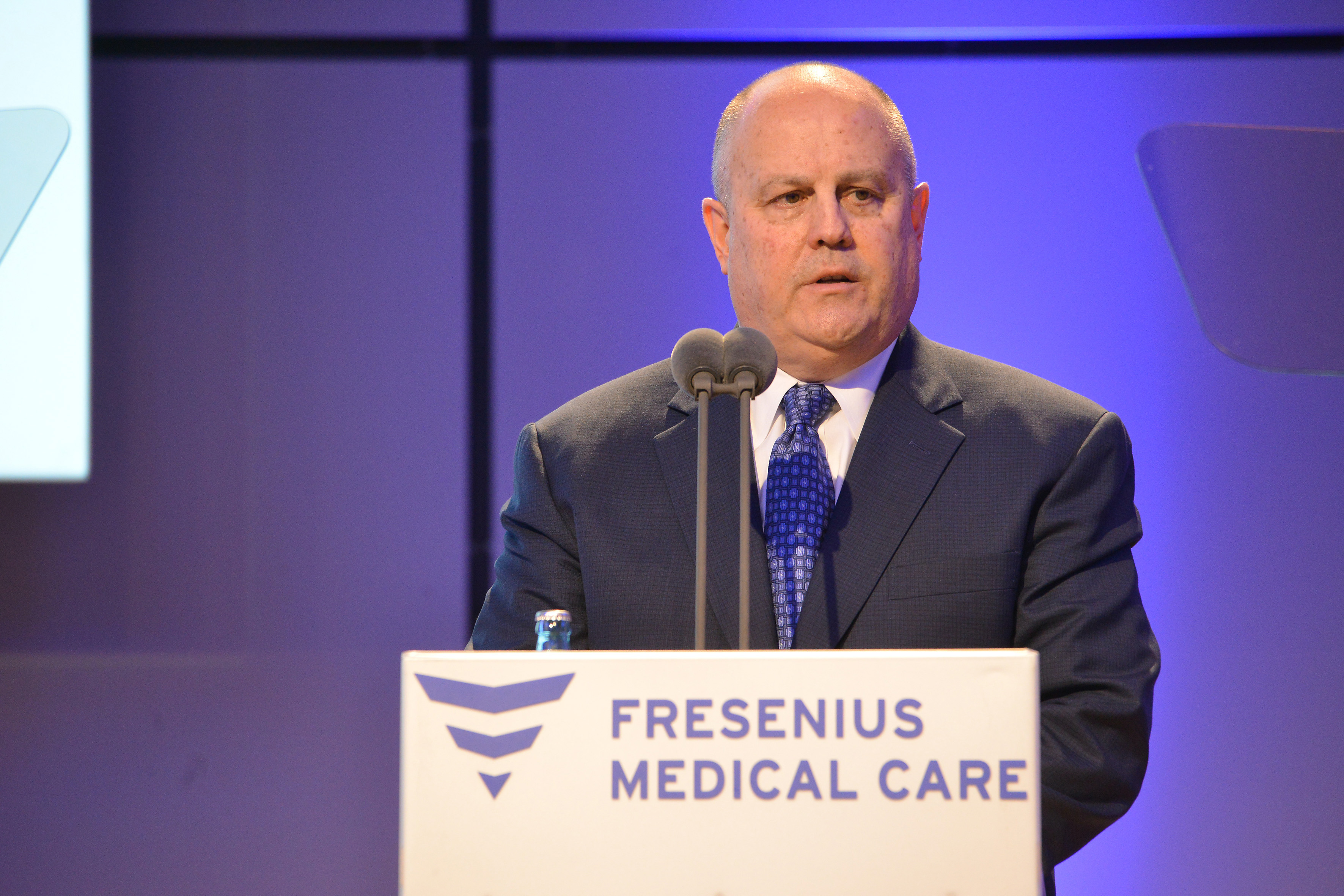
CEO Rice Powell explained the company's growth strategy: “We will be investing to the benefit of our patients – in innovation, efficiency and areas of growth." Download Image (JPG 1.81 MB) -
![]()
A large shareholder majority of 89.78 percent approved the company’s 22nd consecutive dividend increase. The dividend will be raised from €1.06 to €1.17, an increase of 10 percent. Download Image (JPG 1.68 MB) -
![]()
The Annual General Meeting elected two new members to the Supervisory Board: Dr. Dorothea Wenzel, Executive Vice President and Head of the Global Business Unit Surface Solutions at Merck KGaA, and... Download Image (JPG 5.37 MB) -
![]()
... Professor Dr. Gregor Zünd, Chief Executive Officer of the University Hospital of Zurich. Download Image (JPG 10.60 MB)
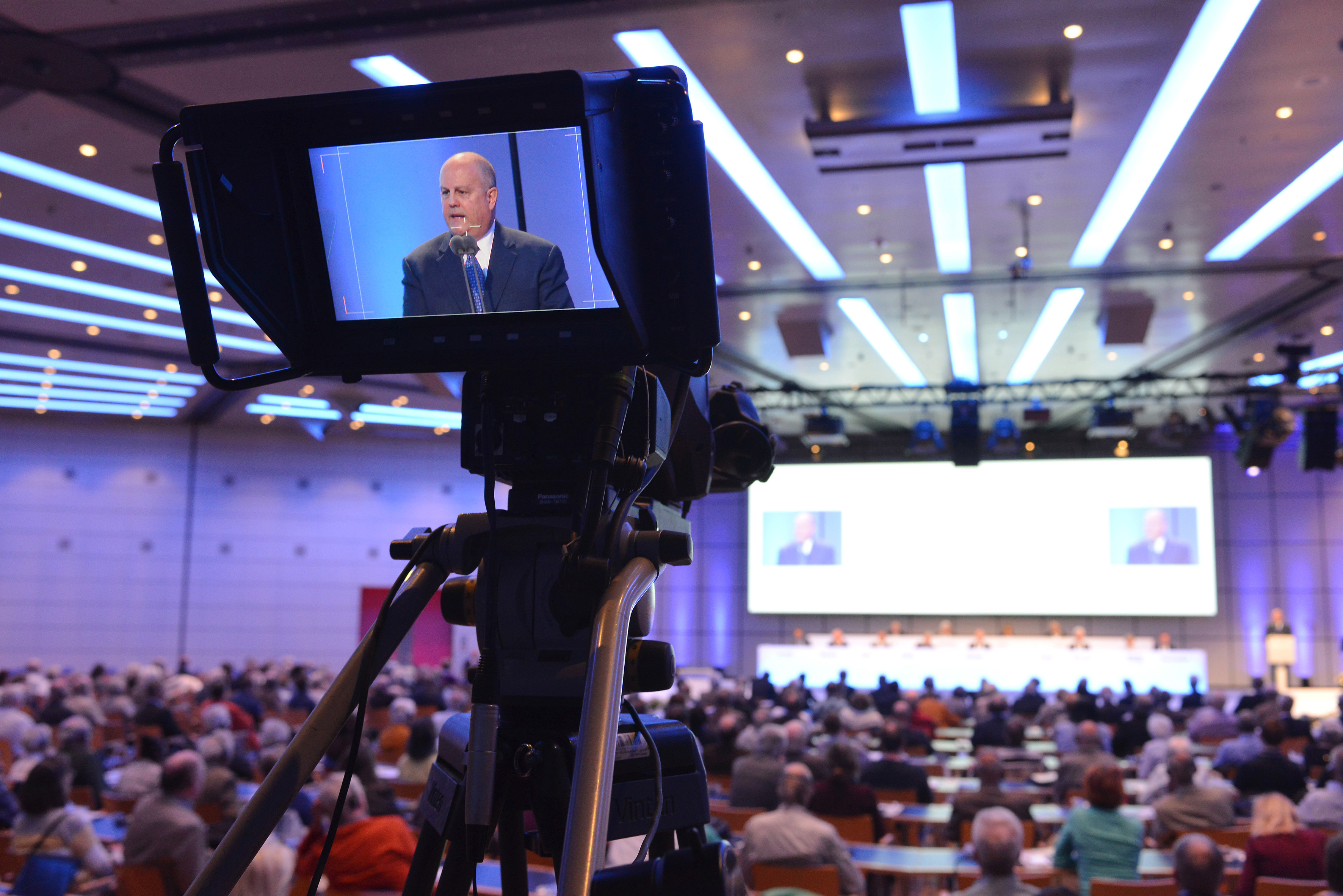

Fresenius Medical Care, the world’s largest provider of dialysis products and services, is investing in further growth. At the Annual General Meeting in Frankfurt today, CEO Rice Powell explained the company's growth strategy: “We will be investing to the benefit of our patients – in innovation, efficiency and areas of growth. We have already taken important steps in this direction: We want to continuously improve dialysis care in a number of ways. Because we are vertically integrated, we are ideally placed to develop innovations for a range of applications, from diagnosis to treatment.”
A large shareholder majority of 89.78 percent approved the company’s 22nd consecutive dividend increase. The dividend will be raised from €1.06 to €1.17, an increase of 10 percent.
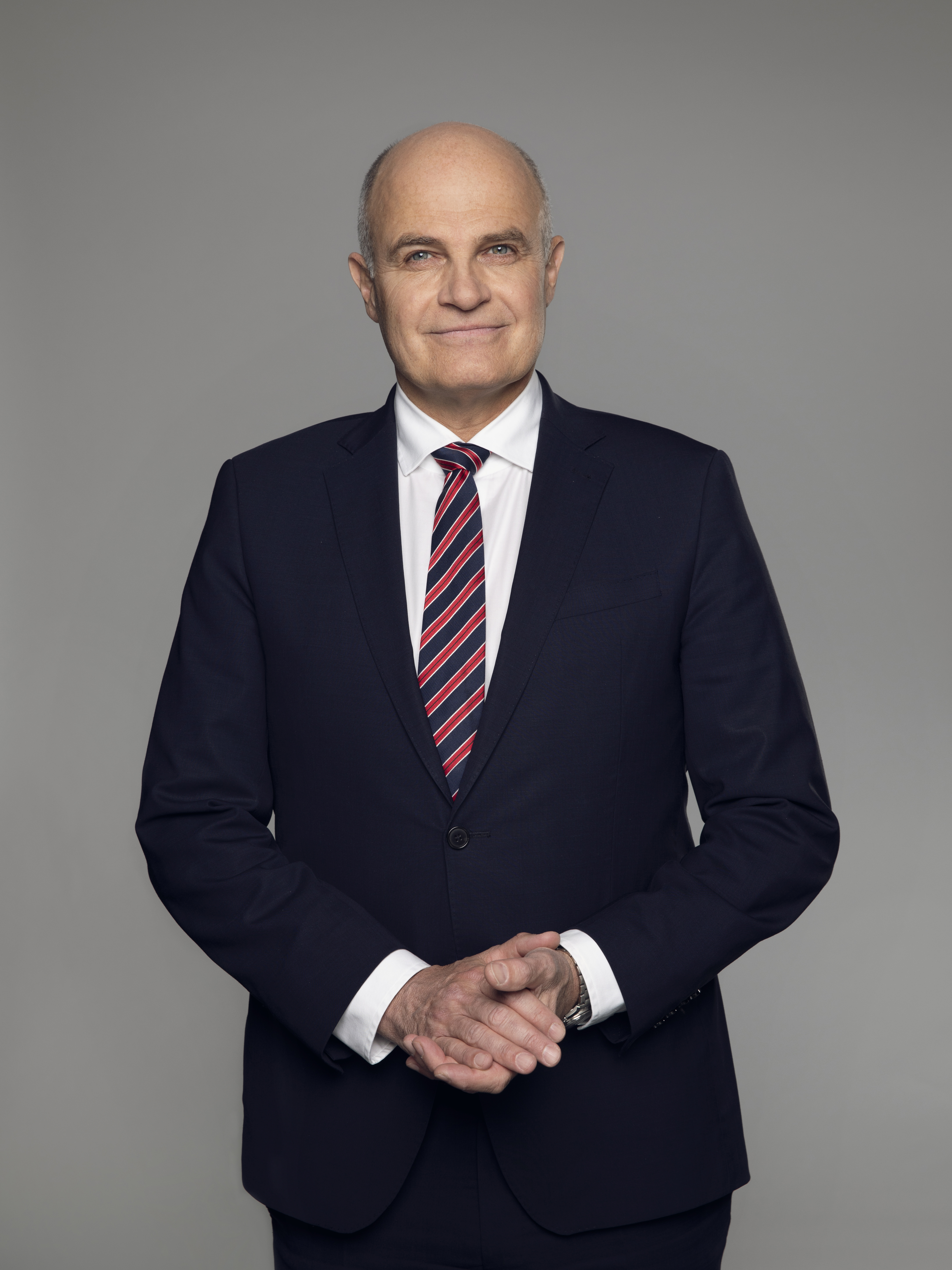
With large majorities, the Annual General Meeting elected two new members as shareholder representatives to the Supervisory Board: Dr. Dorothea Wenzel, Executive Vice President and Head of the Global Business Unit Surface Solutions at Merck KGaA, and Professor Dr. Gregor Zünd, Chief Executive Officer of the University Hospital of Zurich. The two by-elections were necessitated by the departures of Dr. Gerd Krick and Deborah Doyle McWhinney from the Supervisory Board last year.
Shareholder majorities of 56.81 and 52.32 percent, respectively, approved the actions of the General Partner and the Supervisory Board in 2018.
At the Annual General Meeting, 76.68 percent of the subscribed capital was represented.
The next Annual General Meeting is scheduled for May 19, 2020.
This release contains forward-looking statements that are subject to various risks and uncertainties. Actual results could differ materially from those described in these forward-looking statements due to certain factors, including changes in business, economic and competitive conditions, regulatory reforms, foreign exchange rate fluctuations, uncertainties in litigation or investigative proceedings, and the availability of financing. These and other risks and uncertainties are detailed in Fresenius Medical Care AG & Co. KGaA's reports filed with the U.S. Securities and Exchange Commission. Fresenius Medical Care AG & Co. KGaA does not undertake any responsibility to update the forward-looking statements in this release.
-
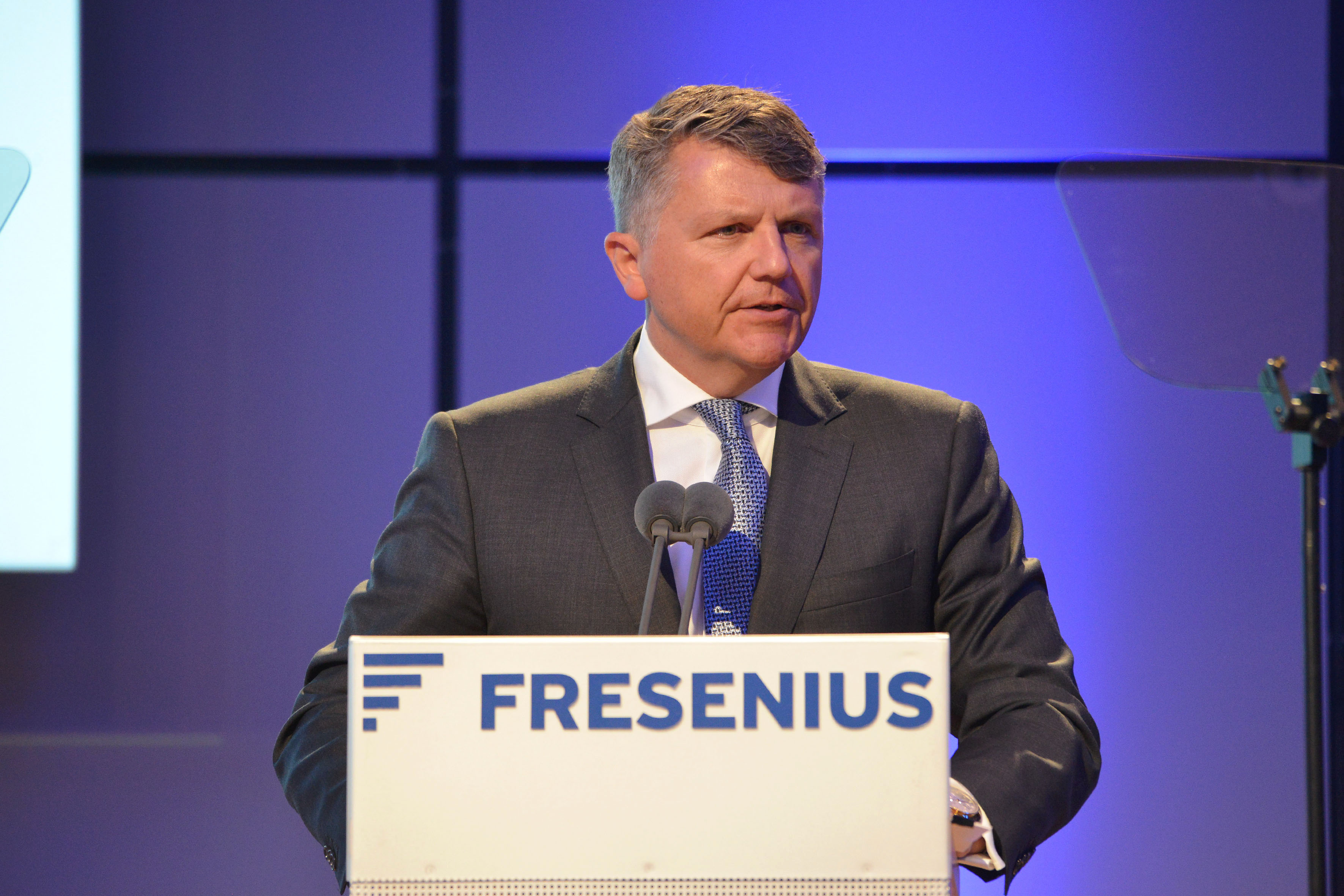
“What we do is more important than ever,” CEO Stephan Sturm said. “The healthcare market is growing. People are living longer, and around the world the demand for high-quality medicine is rising." Download Image (JPG 947 KB) -
![]()
At the Annual General Meeting, 72.46 percent of the subscribed capital was represented. Download Image (JPG 1.36 MB) -
![]()
Shareholder majorities of 98.49 percent and 87.53 percent, respectively, approved the actions of the Management and Supervisory Boards in 2018. Download Image (JPG 930 KB) -
![]()
Shareholders approved with a majority of 90.96 percent the proposal of the General Partner and the Supervisory Board to increase the dividend for the 26th consecutive time. It was raised by 7 percent, to €0.80 per share. Download Image (JPG 932 KB)
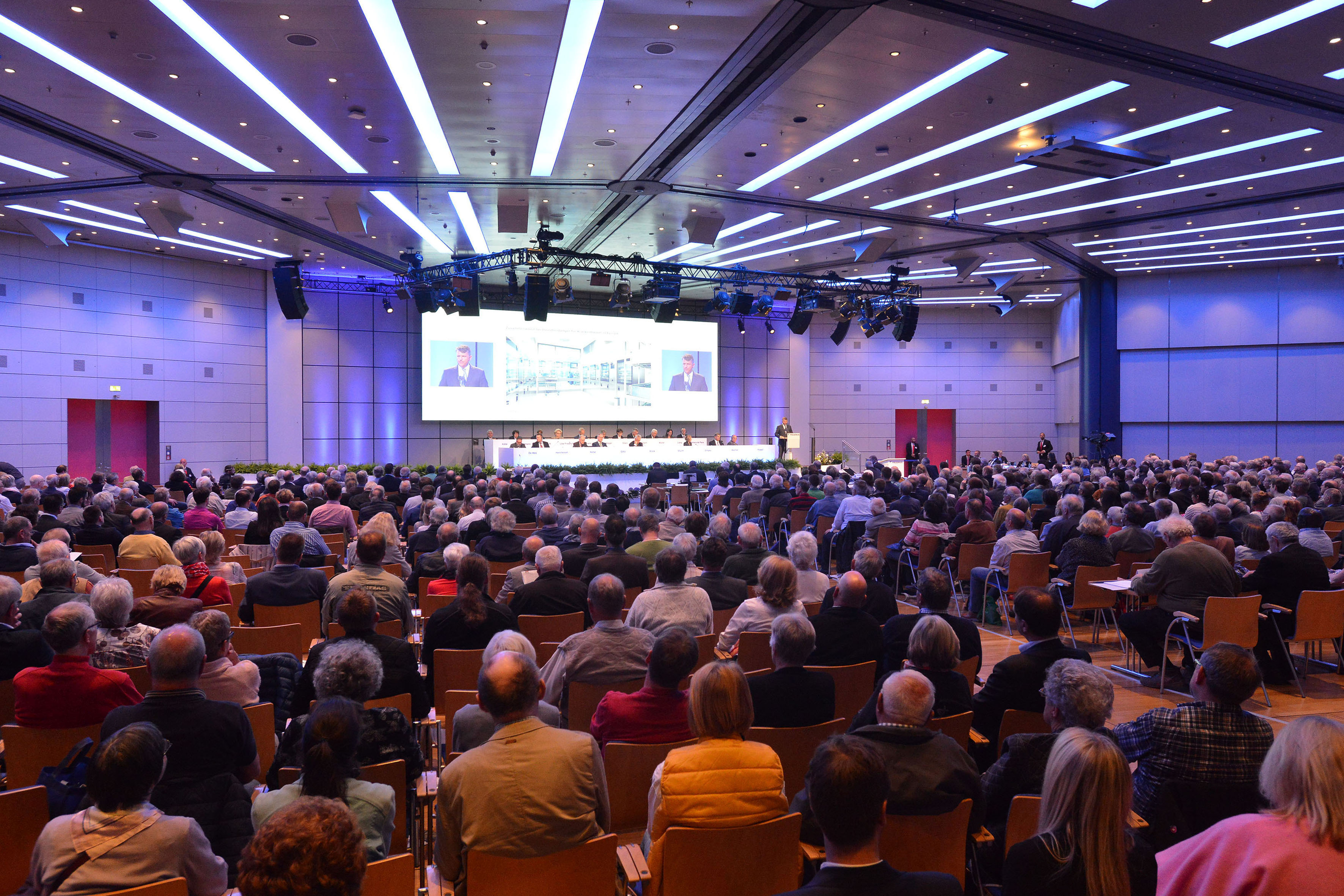
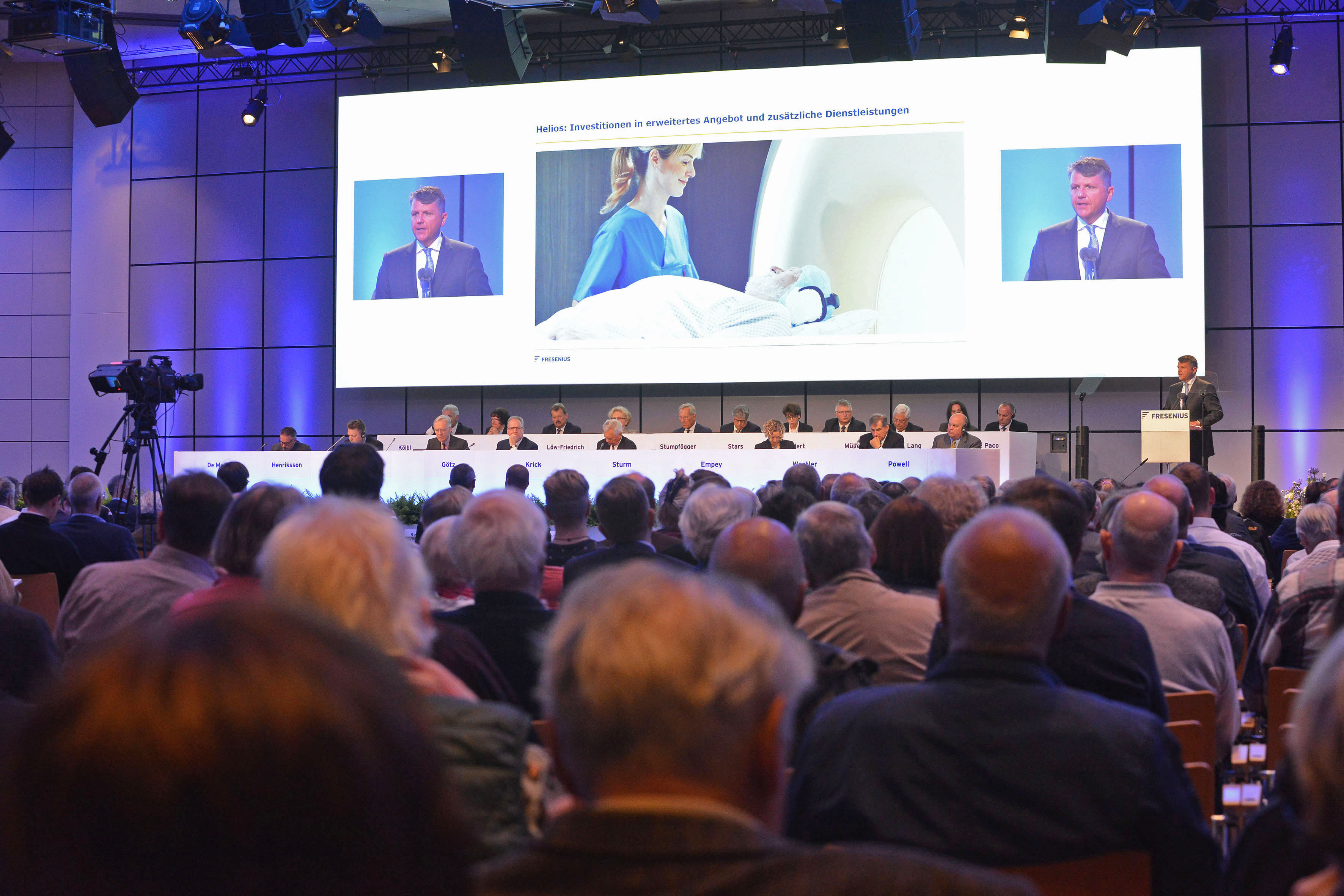
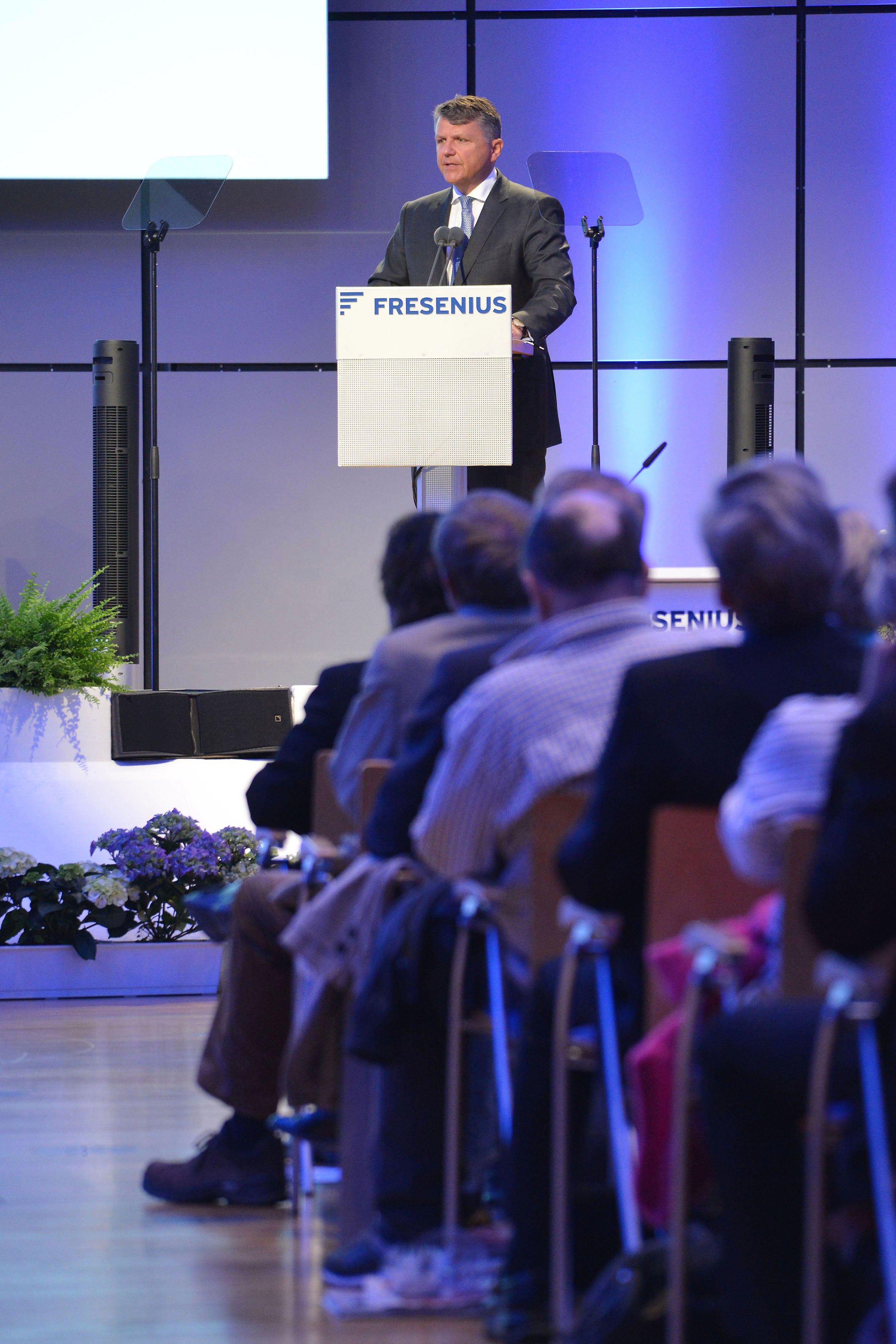
Fresenius remains on course for growth despite some recent challenges, Stephan Sturm, CEO of Fresenius, told the Annual General Meeting in Frankfurt today. “2018 was not an easy year, and yet it was a successful one,” he said in a speech to shareholders. “Fresenius is in very good shape. All indications point to continued, profitable growth.”
The basis for this will be increased investments in the current business year, Sturm said. He confirmed the global healthcare group’s ambitious targets1 for 2020 to 2023 of organic sales growth averaging 4 to 7 percent annually and an average increase in net income2 of 5 to 9 percent.
“What we do is more important than ever,” Sturm said. “The healthcare market is growing. People are living longer, and around the world the demand for high-quality medicine is rising. Needs and expectations are also changing: It is no longer about preserving lives, but about raising quality of life for people well into old age. It is also about keeping quality healthcare affordable. These are big challenges! But challenges that we are superbly positioned to meet.”
1 Before special items
2 Net income attributable to shareholders of Fresenius SE & Co. KGaA
Shareholders approved with a majority of 90.96 percent the proposal of the General Partner and the Supervisory Board to increase the dividend for the 26th consecutive time. It was raised by 7 percent, to €0.80 per share.
Shareholder majorities of 98.49 percent and 87.53 percent, respectively, approved the actions of the Management and Supervisory Boards in 2018.
At the Annual General Meeting, 72.46 percent of the subscribed capital was represented.
This release contains forward-looking statements that are subject to various risks and uncertainties. Future results could differ materially from those described in these forward-looking statements due to certain factors, e.g. changes in business, economic and competitive conditions, regulatory reforms, results of clinical trials, foreign exchange rate fluctuations, uncertainties in litigation or investigative proceedings, and the availability of financing. Fresenius does not undertake any responsibility to update the forward-looking statements in this release.
- Fresenius Kabi with continued good growth in Q1/19
- Helios Germany stabilized; Helios Spain with continued dynamic growth
- Fresenius Medical Care with strong financial performance supported by agreements that materialized earlier than planned
- Growth investments on track
- Group guidance confirmed despite expected earnings dilution from NxStage

1 Adjusted for IFRS 16 effect
2 Q1/18 adjusted for divestitures of Care Coordination activities at FMC
3 Net income attributable to shareholders of Fresenius SE & Co. KGaA
Stephan Sturm, CEO of Fresenius, said: “We have made a successful start into 2019. All four Fresenius business segments have developed in line with our expectations, putting us well on course to meet our targets for the year. High-quality, yet affordable healthcare for ever more patients worldwide is our commitment. Consistent organic growth and major investments into key growth areas continue to reinforce our delivery of that commitment. Those strong foundations will also ensure the long-term success of our business.”
Group guidance for 2019 confirmed
After closing the NxStage acquisition on February 21, the related sales and earnings contributions are now included in the Group guidance. Despite the expected earnings dilution from NxStage, Fresenius confirms its FY/19 guidance. Fresenius projects sales growth1 of 3% to 6% in constant currency. Net income2,3 growth is expected to be ~0% in constant currency.
Including the NxStage acquisition which is increasing the net debt/EBITDA ratio in 2019 by ~30 basis points and excluding IFRS 16, Fresenius now expects year-end 2019 net debt/EBITDA ratio to be at the upper-end of the original self-imposed target corridor of 2.5 to 3.0x.
Due to the adoption of the IFRS 16 accounting standard (“IFRS 16 effect”), Fresenius increases its self-imposed target corridor of 2.5x to 3.0x net debt/EBITDA to 3.0x to 3.5x.
1 On a comparable basis: FY/18 base: €33,009 million; FY/18 adjusted for divestitures of Care Coordination activities at FMC (H1/18); FY/19: adjusted for IFRS 16 effect
2 Net income attributable to shareholders of Fresenius SE & Co. KGaA
3 On a comparable basis: FY/18 base: €1,872 million; FY/18 before special items and adjusted for divestitures of Care Coordination activities at FMC (H1/18); FY/19: before special items (transaction-related expenses, expenses associated with the cost optimization program at FMC, revaluations of biosimilars contingent liabilities); adjusted for IFRS 16 effect
4 Both net debt and EBITDA calculated at expected annual average exchange rates; excluding further potential acquisitions
5% sales growth1 in constant currency
Group sales were €8,495 million including an IFRS 16 effect of -€22 million. Group sales1 on a comparable basis increased by 8% (5% in constant currency) to €8,517 million (Q1/18: €7,870 million). Organic sales growth was 5%. Acquisitions/divestitures contributed net 0% to growth. Positive currency translation effects of 3% were mainly driven by the appreciation of the U.S. dollar against the euro.
Group sales by region:

1 On a comparable basis: Q1/18 adjusted for divestitures of Care Coordination activities at FMC; Q1/19 adjusted for IFRS 16 effect
Net income1,2 growth flat in constant currency
Group EBITDA before special items was €1,701 million including an IFRS 16 effect of €220 million. Group EBITDA2 on a comparable basis increased by 6% (3% in constant currency) to €1,481 million (Q1/18: €1,394 million).
Group EBIT before special items was €1,130 million including an IFRS 16 effect of €19 million. Group EBIT2 on a comparable basis increased by 6% (2% in constant currency) to €1,111 million (Q1/18: €1,050 million). The EBIT margin2 on a comparable basis was 13.0% (Q1/18: 13.3%). Reported Group EBIT was €1,115 million.
Group net interest before special items was -€181 million including an IFRS 16 effect of -€48 million. On a comparable basis, net interest2 improved to -€133 million (Q1/18: -€139 million) mainly due to lower rates for refinancing activities. Reported Group net interest was -€184 million.
Group tax rate before special items and adopting IFRS 16 was 23.3%. Group tax rate2 on a comparable basis was 23.4% (Q1/18: 20.9%). The prior-year was positively influenced by one-time effects related to the adoption of the U.S. tax reform.
Noncontrolling interest before special items was €271 million including an IFRS 16 effect of €13 million. Noncontrolling interest2 on a comparable basis was €284 million (Q1/18: €270 million), of which 94% was attributable to the noncontrolling interest in Fresenius Medical Care.
Group net income1 before special items was €457 million including an IFRS 16 effect of -€8 million. Group net income1,2 on a comparable basis increased by 3% (0% in constant currency) to €465 million (Q1/18: €451million). Reported Group net income1,3 was €453 million.
Earnings per share1 before special items was €0.82 including an IFRS 16 effect of -€0.02.
Earnings per share1 before special items was €0.82 including an IFRS 16 effect of -€0.02. Earnings per share1,2 on a comparable basis increased by 3% (0% in constant currency) to €0.84 (Q1/18: €0.81). Reported Earnings per share1,3 was €0.81.
1 Net income attributable to shareholders of Fresenius SE & Co. KGaA
2 On a comparable basis: Q1/19 before special items and adjusted for IFRS 16 effect; Q1/18 adjusted for divestitures of Care Coordination activities at FMC
3 After special items and including IFRS 16 effect
Continued investment in growth
2019 is an investment year for the Fresenius Group. Fresenius is making good progress in all of its investment initiatives to secure long-term sustainable growth. Spending on property, plant and equipment was €441 million (Q1/18: €380 million), primarily for the modernization and expansion of dialysis clinics, production facilities as well as hospitals and day clinics. This corresponds to 5% of sales.
Total acquisition spending was €1,923 million (Q1/18: €192 million), mainly for the acquisition of NxStage.
Cash flow development
Group operating cash flow was €289 million including an IFRS 16 effect of €171 million. On a comparable basis, Group operating cash flow was €118 million (Q1/18: €236 million) with a margin of 1.4% (Q1/18: 2.9%). After a strong Q4/18, operating cash flow was impacted by working capital changes at Fresenius Kabi, for example by some phasing of payments and stockbuild to prepare for a possible Brexit. Moreover, as in previous years’ first quarters, operating cash flow was influenced by the seasonality in invoicing at Fresenius Medical Care North America. Fresenius does not expect these temporary effects to have a significant impact on FY/19 cash flow.
Given the effects described above in combination with increasing investments, free cash flow before acquisitions and dividends adjusted for IFRS 16 was -€339 million (Q1/18: - €155 million). Free cash flow after acquisitions and dividends adjusted for IFRS 16 was -€2,282 million (Q1/18: -€389 million). The IFRS 16 effect amounts to €171 million respectively. Correspondingly, cash flow from financing activities declined by €171 million.
Solid balance sheet structure
The Group’s total assets were €64,985 million including an IFRS 16 effect of €5,669 million. Adjusted for IFRS 16, Group total assets1 increased by 5% (3% in constant currency) to €59,316 million (Dec. 31, 2018: €56,703 million). Current assets1 grew by 1% (0% in constant currency) to €14,958 million (Dec. 31, 2018: €14,790 million). Non-current assets1 increased by 6% (5% in constant currency) to €44,358 million (Dec. 31, 2018: € 41,913 million).
Total shareholders’ equity was €25,830 million including an IFRS 16 effect of -€167 million. Adjusted for IFRS 16, total shareholders’ equity1 increased by 4% (2% in constant currency) to €25,997 million (Dec. 31, 2018: €25,008 million). The equity ratio was 39.7%. Adjusted for IFRS 16, the equity ratio was 43.8% (Dec. 31, 2018: 44.1%).
Group debt was €26,378 million including an IFRS 16 effect of €5,836 million. Adjusted for IFRS 16, Group debt1 increased by 8% to €20,542 million (8% in constant currency) (Dec. 31, 2018: € 18,984 million). Group net debt was €24,835 million including an IFRS 16 effect of €5,836 million. Adjusted for IFRS 16, Group net debt1 increased by 17% (16% in constant currency) to € 18,999 million (Dec. 31, 2018: € 16,275 million) mainly due to the acquisition of NxStage by Fresenius Medical Care and the negative free cash flow.
As of March 31, 2019, the net debt/EBITDA ratio increased to 3.091,2,3 (December 31, 2018: 2.712,3). Excluding the acquisition of NxStage the net debt/EBITDA ratio was 2.831,2,3 as of March 31, 2019. Including the IFRS 16 effect, the reported net debt/EBITDA ratio increased to 3.532,3.
1 Adjusted for IFRS 16 effect
2 At LTM average exchange rates for both net debt and EBITDA; pro forma closed acquisitions/divestitures
3 Before special items
Increased number of employees
As of March 31, 2019, the number of employees was 283,795 (Dec. 31, 2018: 276,750).
Business Segments
Fresenius Medical Care (Figures according to Fresenius Medical Care Investor News)
Fresenius Medical Care is the world's largest provider of products and services for individuals with renal diseases. As of March 31, 2019, Fresenius Medical Care was treating 336,716 patients in 3,971 dialysis clinics. Along with its core business, the company provides related medical services in the field of Care Coordination.

- 6% sales1,2 growth in constant currency
- Earnings supported by agreements that materialized earlier than planned
- Outlook confirmed
Adjusted for the Q1/18 contribution from the divested Care Coordination activities, the effect of the adoption of the IFRS 16 accounting standard (“IFRS 16 effect”) and the contribution from NxStage, sales increased by 11% (6% at constant currency) to €4,125 million (Q1/18: €3,725 million). Organic sales growth was 6%. Positive currency translation effects of 5% were mainly related to the appreciation of the U.S. dollar against the euro.
Health Care Services sales1,2 increased by 12% (6% at constant currency) to €3,316 million (Q1/18: €2,958 million). Health Care Products sales1,2 increased by 5% (4% at constant currency) to €809 million (Q1/18: €767 million).
In North America, sales1,2 increased by 14% (5% in constant currency) to €2,879 million (Q1/18: €2,523 million). Health Care Services sales1,2 increased by 14% (6% in constant currency) to €2,679 million (Q1/18: €2,339 million).
1 On an adjusted basis: before expenses associated with the cost optimization program, the IFRS 16 effect, excluding effects from NxStage transaction
2 Q1/18 adjusted for divestitures of Care Coordination activities
3 Net income attributable to shareholders of Fresenius Medical Care AG & Co. KGaA
Sales2 outside North America increased by 4% (6% in constant currency) to €1,246 million (Q1/18: €1,202 million). Health Care Services sales2 increased by 3% (8% in constant currency) to €637 million (Q1/18: €619 million). Health Care Product sales2 adjusted increased by 4% (5% in constant currency) to €609 million (Q1/18: €583 million).
Fresenius Medical Care’s EBIT3 increased by 9% (4% in constant currency) to €551 million (Q1/18: €506 million). The EBIT margin3 decreased to 13.4% (Q1/18: 13.6%).
Net income1,3 increased by 8% (3% in constant currency) to €318 million (Q1/18: €296 million).
Operating cash flow was €76 million (Q1/18: -€45 million) with a margin of 1.8% (Q1/18: -1.1%). The increase was mainly driven by the adoption of the IFRS 16 accounting standard leading to a reclassification of the repayment portion of rent to financing activities (€141 million). Adjusted for the IFRS 16 effect, operating cash flow was -€65 million.
For FY/19, Fresenius Medical Care expects adjusted sales to grow by 3% to 7% ,6 in constant currency. Net income1 is expected to develop in the range of -2% to +2% ,7 in constant currency.

For further information, please see Fresenius Medical Care’s Investor News at www.freseniusmedicalcare.com.
1 Net income attributable to shareholders of Fresenius Medical Care AG & Co. KGaA
2 Q1/18 adjusted for divestitures of Care Coordination activities; Q1/19 adjusted for IFRS 16 effects, excluding effects from NxStage transaction
3 Q1/18 before special items and after adjustments; Q1/19 before special items (before transaction-related expenses, expenses associated with the cost optimization program), adjusted for IFRS 16 effect, excluding effects from NxStage transaction
4 Before special items (operating cash flow after special items)
5 Adjusted for IFRS 16 effect
6 FY/18 base: €16,026 million
7 FY/18 base: €1,341 million
Fresenius Kabi
Fresenius Kabi offers intravenously administered generic drugs, clinical nutrition and infusion therapies for seriously and chronically ill patients in the hospital and outpatient environments. The company is also a leading supplier of medical devices and transfusion technology products. In the biosimilars business, Fresenius Kabi develops products with a focus on oncology and autoimmune diseases.

- 4% organic sales growth and 7% EBIT1 growth in constant currency
- High prior-year base impacts organic sales growth in North America
- FY/19 outlook confirmed
Sales increased by 6% (4% in constant currency) to €1,701 million (Q1/18: €1,603 million). Organic sales growth was 4%. Positive currency translation effects of 2% were mainly related to the appreciation of the U.S. dollar against the euro.
Sales in Europe grew by 3% (organic growth: 3%) to €573 million (Q1/18: €557 million). Sales in North America increased by 5% (decreased organically by 2% from a high prior-year basis) to €623 million (Q1/18: €591 million). Sales in Asia-Pacific increased by 13% (organic growth: 11%) to €341 million (Q1/18: €301 million). Sales in Latin America/Africa increased by 6% (organic growth: 18%) to €164 million (Q1/18: €154 million).
EBIT1 increased by 13% (7% in constant currency) to €303 million (Q1/18: €268 million) with an EBIT margin1 of 17.8% (Q1/18: 16.7%).
Net income1,2 increased by 19% (12% in constant currency) to €203 million (Q1/18: €170 million).
Operating cash flow3 was €132 million (Q1/18: €226 million). After a strong Q4/18, operating cash flow was impacted by working capital changes, for example by some phasing of payments and stockbuild to prepare for a possible Brexit. The cash flow margin was 7.8% (Q1/18: 14.1%).
Fresenius Kabi confirms its outlook for FY/19 and expects organic sales growth4 of 3% to 6% and EBIT growth5 in constant currency of 3% to 6%.

1 On a comparable basis: before special items and adjusted for IFRS 16 effect
2 Net income attributable to shareholders of Fresenius SE & Co. KGaA
3 Adjusted for IFRS 16 effect, before special items (operating cash flow after special items)
4 On a comparable basis: FY/18 base: €6,544 million; FY/19 before special items (acquisition-related expenses, revaluations of biosimilars contingent liabilities) and adjusted for IFRS 16 effect
5 On a comparable basis: FY/18 base: €1,139 million; FY/18 before special items; FY/19 before special items (acquisition-related expenses, revaluations of biosimilars contingent liabilities) and adjusted for IFRS 16 effect.
Fresenius Helios
Fresenius Helios is Europe's leading private hospital operator. The company comprises Helios Germany and Helios Spain (Quirónsalud). Helios Germany operates 86 hospitals, ~125 outpatient centers and treats approximately 5.3 million patients annually. Quirónsalud operates 47 hospitals, 56 outpatient centers and around 300 occupational risk prevention centers, and treats approximately 13.3 million patients annually.

- 4% organic sales growth
- Helios Germany stabilized; Helios Spain with continued dynamic growth
- FY/19 outlook confirmed
Sales decreased by 1% (increased by 4%1; organic growth: 4%) to €2,311 million (Q1/18: €2,331 million).
Sales of Helios Germany decreased by 6% (increased by 1%1; organic growth: 2%) to €1,485 million (Q1/18: €1,574 million). Sales were impacted by a decline in admissions in Germany, partially due to the transfer of the post-acute care business from Helios to Vamed, a shortage of nurses at selected intensive care units and a less pronounced flu season. The admission decline was more than compensated by positive price effects.
Helios Spain increased sales by 9% (organic growth: 9%) to €826 million (Q1/18: €757 million), mainly driven by the private sector. The occupational risk prevention business also had a valuable contribution. Performance in Q1/18 was impacted by the Easter holidays.
1 Adjusted for the post-acute care business transferred to Fresenius Vamed as of July 1, 2018
2 Adjusted for IFRS 16 effect
3 Net income attributable to shareholders of Fresenius SE & Co. KGaA
EBIT1 of Fresenius Helios decreased by 4% (-3%2) to €266 million (Q1/18: €278 million) with an EBIT margin of 11.5% (Q1/18: 11.9%).
EBIT1 of Helios Germany decreased by 16% (-14%2) to €149 million (Q1/18: €177 million). The EBIT margin improved sequentially by 50 bps to 10.0% (Q4/18: 9.5%). The development of Helios Germany is impacted by the admissions decline and the investments for preparatory structural measures.
EBIT1 of Helios Spain increased by 16% to €119 million (Q1/18: €103 million), mainly due to the strong operating performance with an EBIT margin of 14.4% (Q1/18: 13.6%).
Net income1,3 decreased by 8% to €176 million (Q1/18: €191 million).
Operating cash flow1 was €91 million (Q1/18: €97 million) with a margin of 3.9% (Q1/18: 4.2%). The decrease is mainly attributable to the increase in days sales outstanding (DSO).
Fresenius Helios confirms its outlook for FY/19 and expects organic sales growth of 2% to 5% and an EBIT1 growth of -5% to -2%.

1 Adjusted for IFRS 16 effect
2 Adjusted for the post-acute care business transferred to Fresenius Vamed as of July 1, 2018
3 Net income attributable to shareholders of Fresenius SE & Co. KGaA
Fresenius Vamed
Fresenius Vamed manages projects and provides services for hospitals and other health care facilities worldwide and is a leading post-acute care provider in Central Europe. The portfolio ranges along the entire value chain: from project development, planning, and turnkey construction, via maintenance and technical management to total operational management.

- Excellent organic sales growth of 31%
- Order backlog at all-time high ‒ strong foundation for future growth
- FY/19 outlook confirmed
Sales increased by 77% (33%1) to €440 million (Q1/18: €249 million). Organic sales growth was 31%, acquisitions contributed 2% to growth. Both the project and the service business showed strong momentum. Sales of the project business increased by 17% to €108 million (Q1/18: €92 million). Sales in the service business grew by 111% (41%1) to €332 million (Q1/18: €157 million), supported by an intensified collaboration with Fresenius Helios.
In Q1/19, EBIT2 increased by 83% (83%2 in constant currency) to €11 million (Q1/18: €6 million) with an EBIT margin of 2.5% (Q1/18: 2.4%). EBIT2 additionally adjusted for the acquisition of the German post-acute care business was €7 million with an EBIT margin of 2.1%.
Net income2,3 increased by 50% to €6 million (Q1/18: €4 million).
Order intake increased by 47% to €383 million (Q1/18: €260 million). As of March 31, 2019, order backlog reached a new all-time high of €2,698 million (Dec 31, 2018: €2,420 million).
Operating cash flow2 increased by 45% to €-23 million (Q1/18: €-42 million) with a margin of -5.2% (Q1/18: -16.9%).
Fresenius Vamed confirms its outlook for FY/19 and expects organic sales growth of ~10% and EBIT growth2 of 15% to 20%.

1 Adjusted for German post-acute care business acquired from Fresenius Helios as of July 1, 2018
2 Adjusted for IFRS 16 effect
3 Net income attributable to shareholders of VAMED AG
Conference Call
As part of the publication of the results for the first quarter 2019, a conference call will be held on May 2, 2019 at 1:30 p.m. CET (7:30 a.m. EST). You are cordially invited to follow the conference call in a live broadcast over the Internet at www.fresenius.com/media-calendar. Following the call, a replay will be available on our website.
For a detailed overview of special items and adjustments please see the reconciliation tables on pages 19-22 of the PDF file.
For additional information on the performance indicators used please refer to our website www.fresenius.com/alternative-performance-measures.
This release contains forward-looking statements that are subject to various risks and uncertainties. Future results could differ materially from those described in these forward-looking statements due to certain factors, e.g. changes in business, economic and competitive conditions, regulatory reforms, results of clinical trials, foreign exchange rate fluctuations, uncertainties in litigation or investigative proceedings, and the availability of financing. Fresenius does not undertake any responsibility to update the forward-looking statements in this release.