

Risk Assessment & Impacts
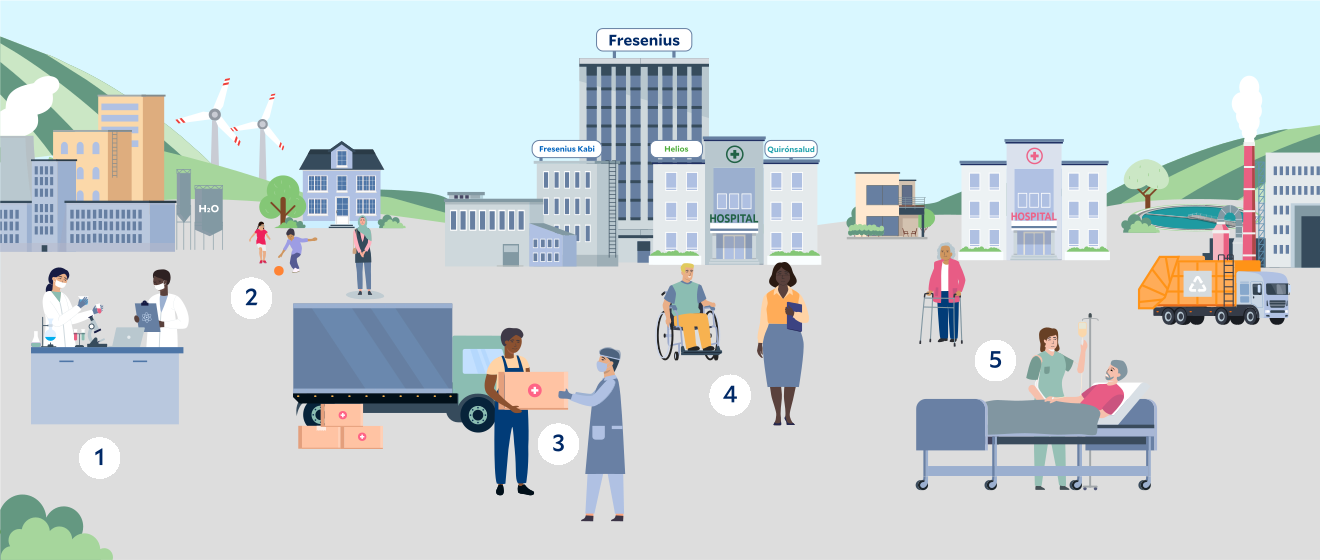
Human rights risks can change over time. We therefore conduct annual and event-related risk analyses in case of substantiated knowledge in our own business locations and at our direct and indirect suppliers. As part of this regular process, we aim to identify human rights risks and impacts in accordance with the requirements of applicable legislation.
Process for identifying and assessing human rights risks
Our approach to identifying and assessing human rights risks is based on three phases: risk identification, risk analysis, and risk assessment and prioritization. The process is illustrated below using the fictional protagonist John.*
*The persons and stories depicted in these images are purely fictional. Any resemblance to actual persons is purely coincidental and unintentional.
-
Risk identification
John works in the Fresenius Human Rights team. In the first phase, he identifies where human rights risks may occur in Fresenius’ own operations or value chains. To do so, he draws on a range of qualitative and quantitative sources, including country- and industry-specific information, audit findings, insights from the misconduct reporting process, and, for suppliers, procurement data.

-
Risk analysis
In the second phase, John reviews whether the identified potential risks indicate actual risks, gaps, or deficiencies that require further analysis. Together with subject matter experts from relevant functions, he uses methods such as interviews, questionnaires, and document reviews to better understand existing processes, responsibilities, and practices.

-
Risk assessment and prioritization
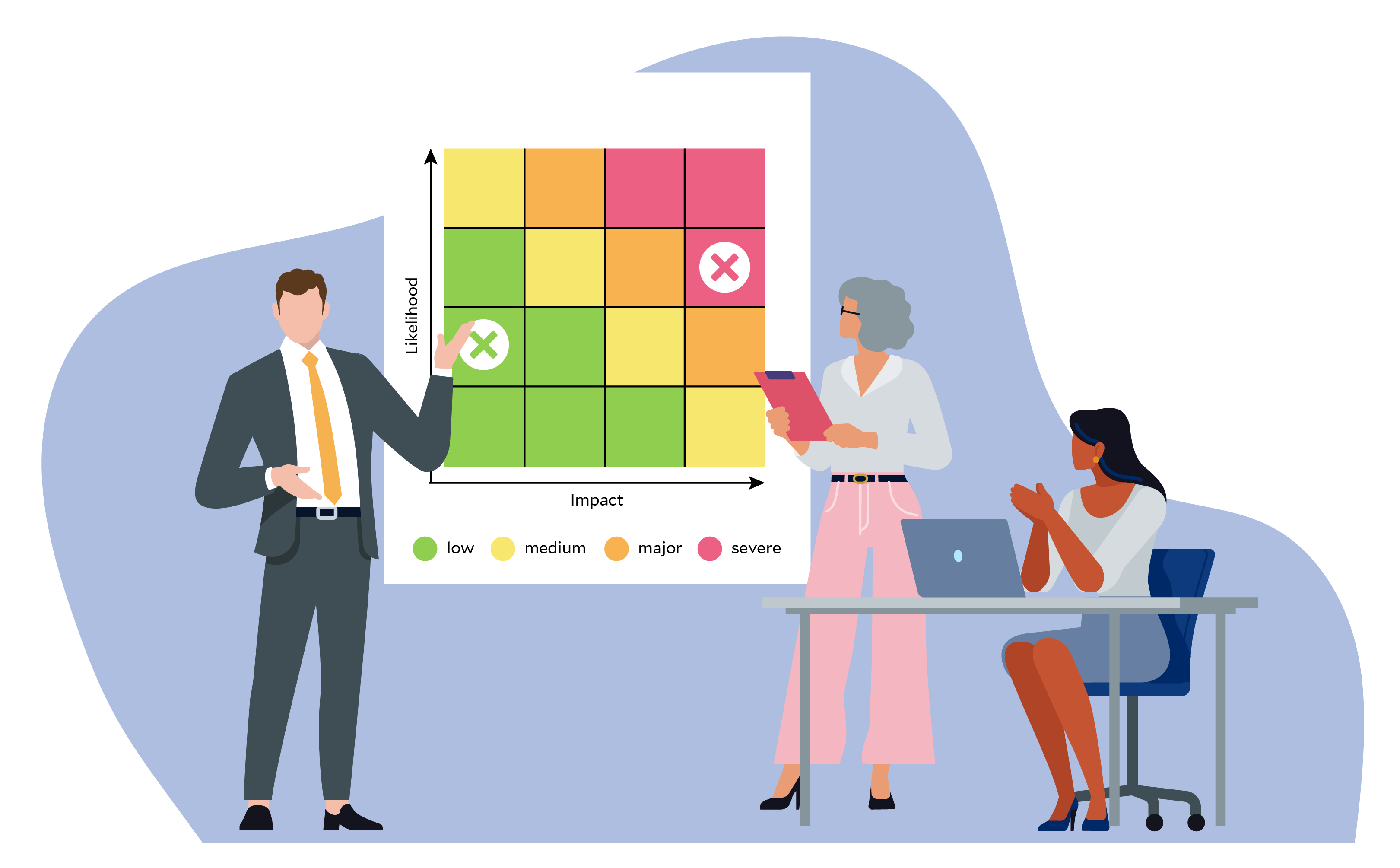
In the final phase, John assesses the relevant risks together with the responsible experts. They evaluate each risk based on the severity of potential impacts on affected individuals and the likelihood of occurrence. This helps them prioritize risks and define an appropriate risk response.
How we evaluate and prioritize human rights risks
To assess and prioritize risks, we evaluate both the potential impact on affected individuals and the likelihood of a risk occurring. The results are visualized in a 4x4 risk matrix. The potential impact ranges from “low” to “severe” and is assessed based on four criteria: scale, scope, possibility for remediation, and company involvement. Likelihood ranges from “unlikely” to “almost certain” and is assessed based on process evaluations, comparable cases, and contextual factors that may increase the probability of a risk materializing.
Results of the risk assessments
We carry out regular risk assessments of human rights topics within our own operations and throughout our value chain in line with applicable international and national requirements. As part of this process, we identify areas that we consider to be of particular relevance based on the potential severity of impacts and our ability to influence them.
Prioritized risks for own operations
Based on our risk assessments, we have identified the following operational-level risks across specific entities and countries:
- Occupational health and safety
- Discrimination and unequal treatment
- Freedom of association
- Working hours and rest periods
Prioritized risks for our value chain
Based on our risk assessments, we have identified the following specific operational-level risks among direct suppliers:
- Compensation and wages
- Freedom of association
- Environmental pollution and waste
Based on the information currently available to us, we have not identified any prioritized risks among indirect suppliers. Further information on our preventive and remedial activities, as well as their implementation, is available here and in our Sustainability Statement.
Human Rights at Fresenius
Our Human Rights ProgramContact
Fresenius SE & Co. KGaA
Else-Kröner-Str. 1
61352 Bad Homburg
Germany
humanrights@fresenius.com
Human Rights Program
Our Human Rights Program Group-wide Governance & Responsibilities Prevention & Remediation Systems and Procedures for Reporting MisconductWhistleblowing system
Reports on possible human rights or other types of compliance violations can be reported around the clock, either anonymously or by name, via our whistleblower system*:
Phone number: +49 (0) 800 181 1338*
https://freseniusgroup.ethicspoint.com
More infos about our grievance mechanism
*The prices of your mobile or landline contract apply
The reporting on the respect for human rights for the year 2024 and following can be found in our Sustainability Report (CSRD Report). Further information on Fresenius' human rights program is available here: fresenius.com/en/human-rights