

Prevention and Remediation
To prevent and reduce human rights risks, we have established standardized preventive measures, including codes and guidelines as well as relevant training. In addition, each Operating Company develops tailored preventive activities based on their specific business measures and value chain risks. Where our own business activities have caused or contributed to human rights violations, we seek to take immediate and appropriate remedial action.
Prevention
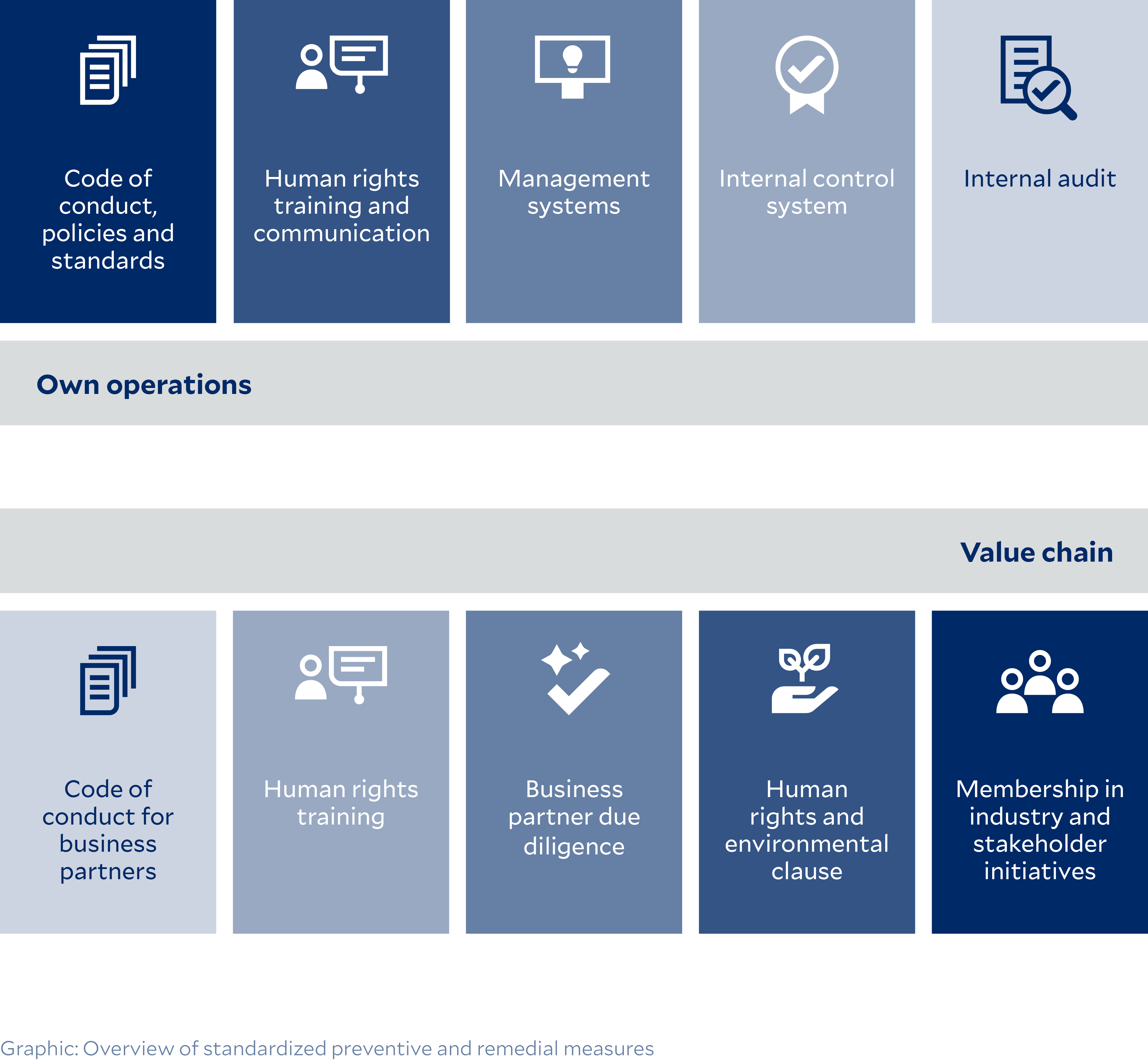
The overview below presents examples of preventive measures within our own operations and throughout our value chain.
Own Operations
Our preventive measures within our own operations include a binding Code of Conduct for employees, a Group Social and Labor Standards Guideline, and occupational health and safety management systems. In addition to human rights training and communication related to our Human Rights Statement, our Internal Control System (ICS) and regular internal audits support the implementation and monitoring of our human rights due diligence obligations.
Value Chain
Our measures throughout the value chain include, among others, Business Partner or Third-Party Codes of Conduct as well as risk-based training on human rights requirements, including information on our systems and procedures for reporting misconduct.
These measures are complemented by risk-based assessments of business partners. Human rights and environmental clauses in contracts, together with our participation in industry and multi-stakeholder initiatives, further support the implementation of our human rights due diligence obligations throughout the value chain.
In addition, within our sphere of influence, we develop targeted measures based on the results of regular and ad hoc risk analyses. These measures are documented accordingly.
Further information on specific measures can be found under Risk Assessment and Impact and in our Sustainability Statement in the chapters S1 and S2.
What are human rights? How can I report a potential violation? And what does human rights due diligence mean in practice? Our employees and business partners should know the answers to these questions if we want to turn our commitment to human rights into action.
To support this objective, we developed a global human rights training program together with colleagues from across our organization. Training is mandatory for employees. Since 2025, it has also been offered as part of our engagement with suppliers. Participation is based on each supplier’s individual risk profile. In this way, we strengthen a shared understanding of human rights due diligence throughout our value chain and foster a responsible corporate culture.
How can we strengthen responsible business practices throughout complex global value chains? And how can we work together with industry peers to promote respect for human rights?
To support these objectives, Fresenius Kabi has been an associate member of the Pharmaceutical Supply Chain Initiative (PSCI) since 2025. The PSCI is a coalition of leading pharmaceutical and healthcare companies that promote responsible supply chain practices and ethical sourcing standards. Through its participation in the initiative, Fresenius Kabi supports the application and continuous development of recognized standards for responsible supply chain practices and respect for human rights throughout global value chains.
“Our membership in the Pharmaceutical Supply Chain Initiative reflects our commitment to shared responsibility, ethical sourcing, and collaboration — all essential to driving respect for human rights across our value chain.”
Marco Kraemer, Director Supplier Quality Management & Human Rights Function, Fresenius Kabi

Remediation
The objective of remediation is to end, mitigate, and – where possible – reverse human rights or environmental harm. To assess effectiveness, we review the implementation of agreed measures at defined intervals. Where necessary, additional steps are initiated. A case is only considered closed once all planned measures have been fully implemented.
To effectively address adverse impacts on rightsholders, we have developed a practical toolbox for human rights remediation. It is intended for colleagues involved in investigating human rights and environmental violations and includes several components. These include general guidance on remediation in line with the German Supply Chain Due Diligence Act (LkSG) as well as internationally recognized standards and principles, additional guidance on addressing specific human rights violations, and guidance for assessing the effectiveness of remediation.
Appropriateness and effectiveness review of the measures taken
The effectiveness of preventive and remedial approaches is continuously reviewed following their implementation. This includes considering insights from risk assessments and, where appropriate, feedback from potentially affected stakeholders and their representatives. These insights are used to further refine existing processes and tools and may help shape additional approaches where needed.

Human Rights at Fresenius
Our Human Rights ProgramContact
Fresenius SE & Co. KGaA
Else-Kröner-Str. 1
61352 Bad Homburg
Germany
humanrights@fresenius.com
Human Rights Program
Our Human Rights Program Group-wide Governance & Responsibilities Risk Assessment & Impacts Systems and Procedures for Reporting MisconductWhistleblowing system
Reports on possible human rights or other types of compliance violations can be reported around the clock, either anonymously or by name, via our whistleblower system*:
Phone number: +49 (0) 800 181 1338*
https://freseniusgroup.ethicspoint.com
More infos about our grievance mechanism
*The prices of your mobile or landline contract apply
The reporting on the respect for human rights for the year 2024 and following can be found in our Sustainability Report (CSRD Report). Further information on Fresenius' human rights program is available here: fresenius.com/en/human-rights