

(Published: April 2026)
April 7 marks World Health Day, which in 2026 is held under the motto “Together for health. Stand with science.” It highlights the importance of scientific evidence and collaboration as the foundation for progress in medicine and better patient care.
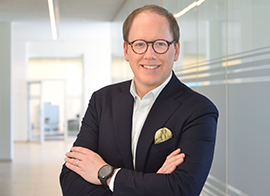
These advances do not happen by chance. They are the result of intensive research, continuous innovation efforts, and close international collaboration between science, industry, and clinical practice. This ambition also applies to Fresenius. Across our company, many of our approximately 175,000 employees work every day across all segments to translate scientific insights into tangible improvements in diagnostics, medicines, and patient care. Prof. Dr. med. Ralf Kuhlen, Chief Medical Officer, Corporate Development, Fresenius, puts it succinctly: “We aim to turn scientific evidence into better care – standing with science with the goal of making treatments more efficient, safer, more reliable, and accessible for more patients.”
From patient journey to scientific progress at Helios
One of those patients is Benjamin Kaiser. When he visits his general practitioner after two weeks of persistent abdominal pain, he does not expect a diagnosis that will fundamentally change his life within hours. But in the days to come, further diagnostics provide certainty: an aggressive B-cell lymphoma. Exhausting examinations follow, along with initial immunochemotherapy. But after six cycles, it becomes clear: the tumor has not regressed; it has continued to grow. For the 37-year-old, further treatment options needed to be considered. In this situation, CAR T-cell therapy represents a standard treatment approach. In Germany, at this period of time, this therapy was no longer restricted. However, as this therapy requires highly specialized expertise, it is typically performed only at selected centers; one of the reasons why Benjamin is referred to the specialized treatment center at Helios Klinikum Berlin-Buch.
The fact that this therapy is available today in Germany is the result of international clinical research and the active involvement of our Helios colleagues. The team in Berlin-Buch participated in the TRANSFORM study and enabled patients to gain early access to this innovative treatment. Since 2019, CAR T-cell therapies have been performed here on a regular basis. At the same time, researchers are investigating how the therapy can be used in earlier stages of the disease and are analyzing large European registry datasets to better understand which treatments are most effective for which patients.
Dr. Anna Ossami Saidy, a resident physician in Prof. Glaß’s team and a member of the European Lymphoma Working Group, analyzes data from the EBMT registry. “Only by evaluating large volumes of patient data can we understand which therapy works best for which patient, and further develop treatments in a targeted way,” she says. “But this always requires the cooperation of patients.” Her findings show that different CAR T-cell products are similarly effective in comparable cases, an important step toward more individualized treatment decisions. The project was awarded at the EBMT Congress 2026.
For Benjamin Kaiser, this research has had a direct impact: today, no residual tumor is detectable. He plans to return to work, while knowing that follow-up care remains essential. His willingness to make his data available for research is a given for him. One thing becomes clear: Medical progress does not only happen in laboratories, it also depends on patients who are willing to be part of it.
Research driven by Fresenius Kabi teams
While decisions on patients’ wellbeing are made every day in intensive care units, another factor is increasingly coming into focus at Fresenius: the clinical nutrition of critically ill patients. This is where Fresenius Kabi initiatives come in – driven by researchers and medical experts who aim to advance patient care through science.
Fresenius Kabi invests in the next generation of researchers. Through the international JUMPstart programs, they support young physicians and scientists worldwide with mentoring and training. The goal is to develop their own studies, from initial ideas to implementation. In this way, a growing network of committed researchers is emerging, generating new momentum for medical nutrition, both in intensive care and in chronic diseases.
On top of that, in cooperation with the European Society of Intensive Care Medicine (ESICM), Fresenius Kabi teams from Medical Clinical & Scientific Affairs support concrete research projects in nutrition therapy. Through the ESICM-Fresenius Kabi Medical Nutrition Research Grant, they fund studies addressing key questions of care, such as metabolism, nutrient requirements, and effective nutritional strategies for critically ill patients. Fellowships and training programs also enable young intensive care physicians to translate new insights directly into clinical practice.
The two Fresenius Kabi programs complement each other: while the ESICM cooperation brings current research into practice, JUMPstart builds the foundation for future care. Both initiatives aim to build scientific evidence and translate it more rapidly into clinical practice and thereby improve the care of critically ill & chronically ill patients.
Initiatives such as the EASYGEN consortium also show how collaboration between industry, hospitals, and academia can advance new therapeutic approaches, for example by working to enable decentralized manufacturing of CAR-T cell therapies and improve patient access. “Fresenius-Kabi aims to empower EASYGEN initiatives through the development and deployment of the next generation of Cue cell processing system which utilizes a novel method of T cell selection for closed, autologous CAR T cell manufacturing at scale – facilitating a dual system integration that is being pursued via a pivotal collaboration with TQ Therapeutics”, explains Paige Bothwell, Research Scientist, Fresenius Kabi Research Technologies. The consortium brings together a total of 18 partners and includes _ besides Fresenius Kabi - Fresenius, Helios and Quirónsalud as active participants.
In parallel, Fresenius Kabi’s activities in Pharma focus on providing essential medicines. This includes IV drugs and infusion solutions that are integral to many treatment protocols, particularly in oncology and critical care.
A central pillar of our Biopharma Business Unit is the development of biosimilars – biologic medicines that match reference products in quality, safety, and efficacy while helping to manage healthcare costs. Based on a vertically integrated model from research and development to distribution, Fresenius Kabi is committed to building resilience and reliability across its biosimilar supply chain. In this way, scientific innovation is translated into broader access to effective treatments and more sustainable healthcare systems.